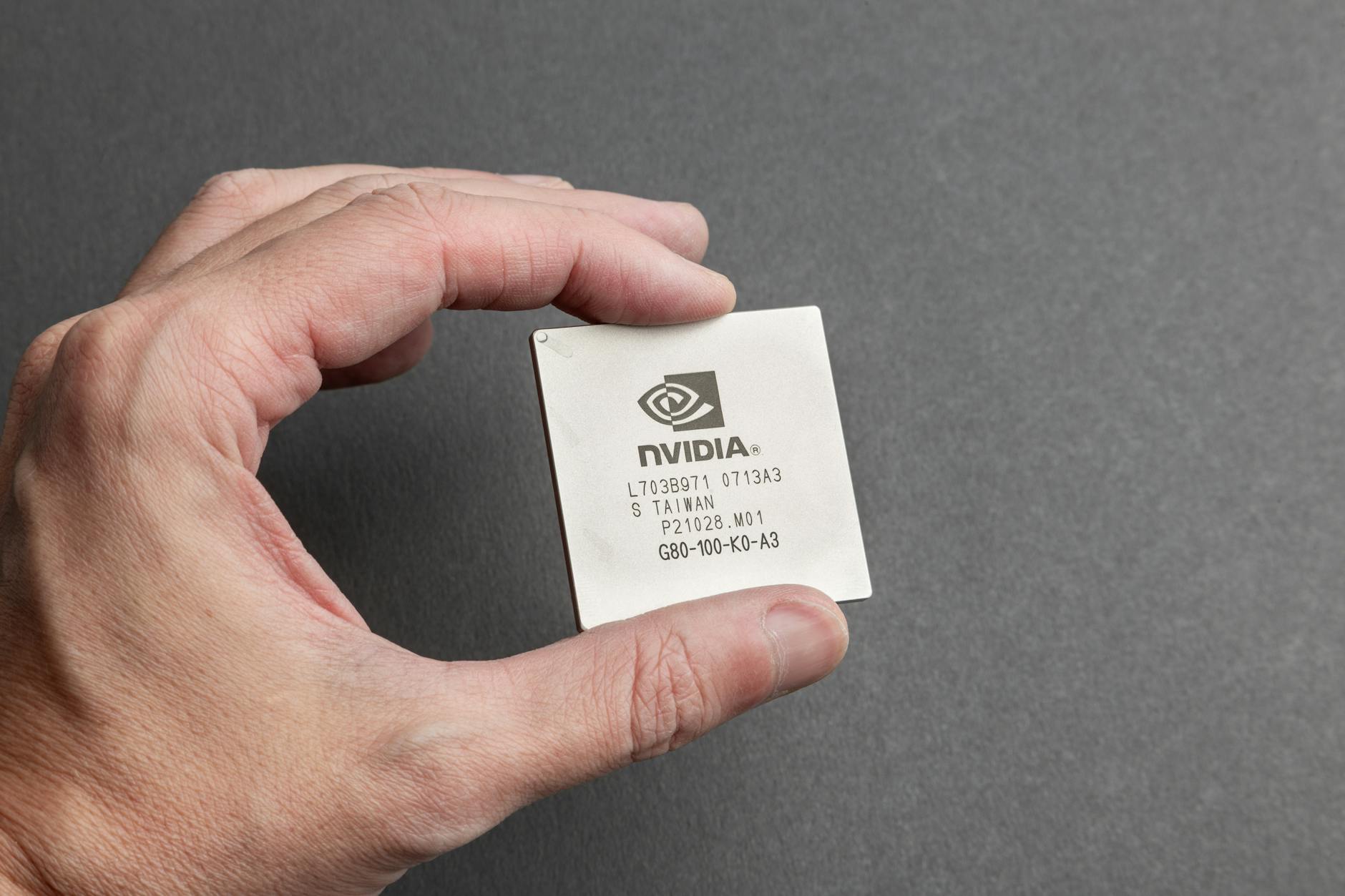

Ondas Holdings is positioning itself as a potential next-generation defense technology giant, though “next Nvidia” requires important context: unlike Nvidia’s dominance in general-purpose computing infrastructure, ONDS is building a vertically integrated defense robotics company focused on specific operational gaps in autonomous systems, ISR, and command integration. The company’s 1,100%+ stock surge and $5 billion market cap reflect investor confidence, but the comparison to Nvidia—which took decades to achieve trillion-dollar valuation and horizontal market adoption—suggests either extraordinary execution ahead or valuation that prices in perfect execution. What makes ONDS noteworthy isn’t that it mirrors Nvidia’s path, but that it’s attempting something both more focused and riskier: consolidating fragmented defense robotics capabilities into a coherent platform that federal agencies actually purchase. The numbers are striking.
In Q1 2026 alone, ONDS generated $50.1 million in revenue—a staggering leap from $4.3 million in Q1 2025. The company projects at least $390 million for full-year 2026. This growth has been fueled by contracts like $10 million in newly secured autonomous defense system orders, the DCMA Blue UAS approval for rapid federal procurement of its American Robotics Optimus Drone, and a strategic partnership with Palantir to integrate AI-driven intelligence and command capabilities. For roboticists and defense technologists, ONDS represents a rare moment when a pure-play autonomous systems company gains actual scale—but scale in a sector where government procurement cycles, geopolitical shifts, and competition from larger defense contractors can reverse momentum quickly.
Table of Contents
- How ONDS Weaponized Rapid Federal Procurement for Growth
- The Palantir Partnership and AI-Driven Command Integration
- The Omnisys Acquisition and Battle-Level AI Optimization
- Federal Procurement Approval as Competitive Moat and Market Accelerator
- The Valuation Question and Reality Check
- Competitive Landscape and Defense Robotics Consolidation
- The Broader Robotics Industry and What ONDS Signals
- Conclusion
How ONDS Weaponized Rapid Federal Procurement for Growth
ONDS didn’t reach $50 million in quarterly revenue by innovating in a vacuum. It succeeded by solving a problem the U.S. Department of Defense has struggled with for years: getting proven autonomous systems into the field fast. The company’s American robotics Optimus Drone—a “drone-in-a-box” system designed for persistent surveillance, counter-UAS, and rapid deployment—earned approval on the DCMA Blue UAS Cleared List, which streamlines federal purchasing for unmanned systems that meet security and performance standards. This single regulatory approval unlocked a purchasing pathway that typically takes defense contractors years to navigate.
Compare this to traditional aerospace companies like General Dynamics or Lockheed Martin, which operate under long-lead government contracts but move through bureaucracy with predictable inertia. ONDS moved faster by building products specifically designed for existing federal procurement mechanisms rather than waiting for custom contracts. The revenue acceleration from $4.3 million to $50.1 million in a single year wasn’t organic growth—it reflects a company executing a procurement strategy while the door to rapid federal sales remains open. The drone portfolio includes autonomous surveillance, counter-UAS capabilities, and integrated robotics platforms. However, this rapid growth comes with an implicit risk: if federal priorities shift (toward different threat types, larger platforms, or integrated ecosystems that favor incumbent contractors), ONDS’ growth could plateau. Defense budgets are large but not infinitely flexible, and the company faces competition from established players like AeroVironment (AVAV) and more recent entrants like Shield AI that also pursue federal contracts.

The Palantir Partnership and AI-Driven Command Integration
ONDS’ strategic partnership with Palantir Technologies marks a pivot from pure hardware to software-integrated platforms. Rather than selling standalone drones, ONDS is building systems that feed autonomous reconnaissance directly into Palantir’s Gotham platform, which provides real-time intelligence synthesis, pattern recognition, and command integration. this is where the “nvidia” comparison gains partial legitimacy: Nvidia didn’t win the AI era by making graphics cards; it won by becoming the computational backbone that every AI company had to build around. ONDS is attempting something analogous in defense—becoming the autonomous hardware backbone that sits inside Palantir’s intelligence synthesis ecosystem.
The Palantir integration creates defensible competitive moat. A Defense Department unit using Optimus Drones integrated with Gotham doesn’t just get surveillance footage; it gets automated threat analysis, pattern-of-life intelligence, and command suggestions generated by Palantir’s AI. Switching costs become real because the data pipeline, the AI models trained on that pipeline, and the operational procedures built around it are all entangled. However, this integration also creates dependency risk: if Palantir’s government business faces security scrutiny (the company has faced occasional resistance from privacy advocates) or if another contractor’s AI platform gains favor with specific military branches, ONDS loses the multiplier effect of the integration strategy. The company’s revenue growth assumes sustained adoption of the Palantir-ONDS stack across federal agencies—a bet on one partnership in a risk-averse procurement environment.
The Omnisys Acquisition and Battle-Level AI Optimization
ONDS’ agreement to acquire Omnisys Ltd., an Israeli AI-powered Battle Resource Optimization software company, reveals where the company sees real competitive leverage: not in autonomous hardware alone, but in AI that optimizes how defense units deploy and coordinate that hardware in real time. Omnisys specializes in algorithms that allocate resources—drones, personnel, logistics, electronic warfare assets—across a battlefield in response to dynamic threats. This is applied AI at a scale most robotics companies never reach; it’s the difference between having a fleet of intelligent drones and having software that tells you what to do with that fleet when threats emerge. This acquisition targets a genuine military need: as autonomous systems proliferate, the bottleneck shifts from “can we build drones?” to “can we coordinate them effectively under adversarial conditions?” An example is the ongoing conflict in Ukraine, where drones have proven transformative, but coordination failures have sometimes limited their impact.
Omnisys’ optimization software, integrated into ONDS’ platform, could theoretically help allied forces coordinate swarms of heterogeneous robots (drones, ground units, sensors) with less human overhead. The limitation here is that ONDS is acquiring unproven software integration; Omnisys is Israeli-founded, and the acquisition itself may face regulatory scrutiny from CFIUS (Committee on Foreign Investment in the United States) if the technology is deemed sensitive. Additionally, military customers are historically skeptical of AI systems that make resource-allocation decisions without clear human override, particularly in contested environments. ONDS will face pressure to prove that Omnisys’ algorithms enhance human decision-making rather than replace it.

Federal Procurement Approval as Competitive Moat and Market Accelerator
The DCMA Blue UAS Cleared List approval for the Optimus Drone is more significant than it might appear to non-defense observers. Typically, a defense contractor spends 18-36 months navigating security certifications, technical reviews, and interoperability testing before the Department of Defense authorizes rapid purchasing. ONDS compressed this timeline—or inherited it from American Robotics, the company behind the Optimus platform before ONDS’ consolidation. Once approved, agencies can purchase directly without competitive bids for every unit, which accelerates deployment and shifts risk away from procurement officers (if a cleared platform fails, the government has recourse; if an untested system fails, the procurement officer bears accountability risk).
This approval explains the $50 million quarterly revenue jump more clearly than any marketing narrative. When DCMA approval is combined with Palantir integration and $10 million in new orders, ONDS has created a selling motion that didn’t exist before: federal customers can now buy an integrated autonomy-plus-intelligence stack quickly and with reduced procurement risk. The downside is that approval is conditional on performance and security standards. If the Optimus Drone experiences significant field failures, or if cybersecurity vulnerabilities emerge, the government can revoke approval—potentially wiping out a material portion of ONDS’ accessible market. Unlike commercial drone vendors (DJI, Auterion) that face tariffs and sanctions but not procurement-level approval revocation, ONDS operates in a regulatory environment where a single negative audit can reset years of market access.
The Valuation Question and Reality Check
ONDS’ market cap of approximately $5 billion on ~$50 million quarterly revenue (annualizing to roughly $200 million for 2026, with company guidance for $390 million) implies investors are pricing in sustained hypergrowth, successful product-market fit in defense robotics, and ecosystem expansion. For context, Nvidia’s forward valuation multiples sit in the 25-35x range; ONDS at $5 billion valuation and $390 million projected 2026 revenue is trading at roughly 13x forward revenue—cheaper than Nvidia but expensive relative to traditional defense contractors like Northrop Grumman (~1.5x) or Raytheon (~1.8x). This suggests the market sees ONDS as a growth story, not a mature defense utility.
The risk is binary. If ONDS executes—successfully integrating Omnisys, maintaining federal procurement momentum, and expanding its platform to multiple customer bases (international allies, commercial security applications)—the valuation could sustain or compress as margins improve and growth continues. But if federal buying cycles slow, if a competitor with larger integration resources (say, Microsoft or Amazon’s defense tech arms) captures the AI-robotics-intelligence fusion market, or if procurement priorities shift away from autonomous ISR drones toward crewed systems or directed energy, ONDS faces a significant correction. The company has delivered extraordinary growth in 2025-2026, but growth stocks in defense tech are perpetually hostage to geopolitical conditions and procurement whims.

Competitive Landscape and Defense Robotics Consolidation
ONDS is not unopposed. AeroVironment (AVAV) is a public, established defense contractor with a larger revenue base and proven procurement relationships. Shield AI is well-funded and focused on AI for autonomous combat systems. General Robotics is innovating in ground-based autonomous systems.
However, ONDS’ advantage is consolidation: by acquiring American Robotics and Omnisys, and by partnering with Palantir, ONDS is assembling a vertical stack (hardware, AI optimization, intelligence integration) that competitors address piecemeal. AeroVironment excels at drones but lacks Palantir integration; Palantir excels at intelligence but doesn’t make the platforms feeding it data. This concentration strategy has worked for companies in adjacent spaces—Lockheed Martin’s acquisition of Sikorsky (helicopters) and integration into its broader defense ecosystem created defensible value. If ONDS can execute similarly—turning ONDS-Optimus-Palantir into a sticky combination that federal customers build operations around—the company could command premium valuations and sustained margins. The downside is execution risk: integrating Israeli software, scaling manufacturing, and maintaining procurement relationships across multiple administrations and military branches is operationally complex.
The Broader Robotics Industry and What ONDS Signals
ONDS’ momentum reflects a broader shift in defense spending toward autonomous systems and AI-enhanced operations. Global defense budgets are rising, and geopolitical tension (Ukraine, Taiwan strait, other regional conflicts) has elevated demand for persistent surveillance and autonomous coordination. Companies like Boston Dynamics (Hyundai-owned), Clearpath Robotics, and others are pushing boundary on hardware; ONDS is signaling that the money and acceleration in defense robotics will accrue to companies that solve the full stack—hardware, autonomy, and integration.
Looking ahead, ONDS faces a choice point in 2027-2028. If the company can maintain federal procurement momentum while expanding to allied nations (UK, Australia, Japan, Canada all have equivalent procurement pathways) and demonstrating that the Omnisys integration materially improves battlefield outcomes, ONDS could become a foundational platform in Western defense robotics. If procurement cycles slow or geopolitical priorities shift, the company will face margin pressure and valuation compression. The next 24 months will determine whether ONDS is a generational opportunity or a well-executed but ultimately narrow defense contractor.
Conclusion
ONDS is not exactly the “next Nvidia” in the sense of broad horizontal dominance across multiple industries. Rather, it is demonstrating what consolidation and vertical integration can achieve in a specific, high-demand defense niche at a moment when federal procurement is accelerating and geopolitical pressure favors autonomous systems over personnel-intensive alternatives. The company’s $50 million Q1 2026 revenue, $390 million full-year target, and 1,200% stock surge reflect real execution: federal approval for rapid procurement, strategic partnerships that create defensible moats, and acquisition of complementary AI capabilities.
The parallel to Nvidia is instructive but incomplete. Nvidia succeeded by becoming indispensable infrastructure that everyone had to build around; ONDS is attempting something similar in defense, but in a sector where government procurement is opaque, geopolitical circumstances shift quickly, and competitors with larger resources can quickly mobilize if federal priorities change. For investors, technologists, and defense strategists watching the autonomous systems space, ONDS represents either a genuine foundational layer in the next-generation defense stack or an extraordinarily well-timed winner in a narrow market segment. The distinction will become clear as federal buying patterns stabilize and as the Omnisys integration proves its worth in real operational contexts.