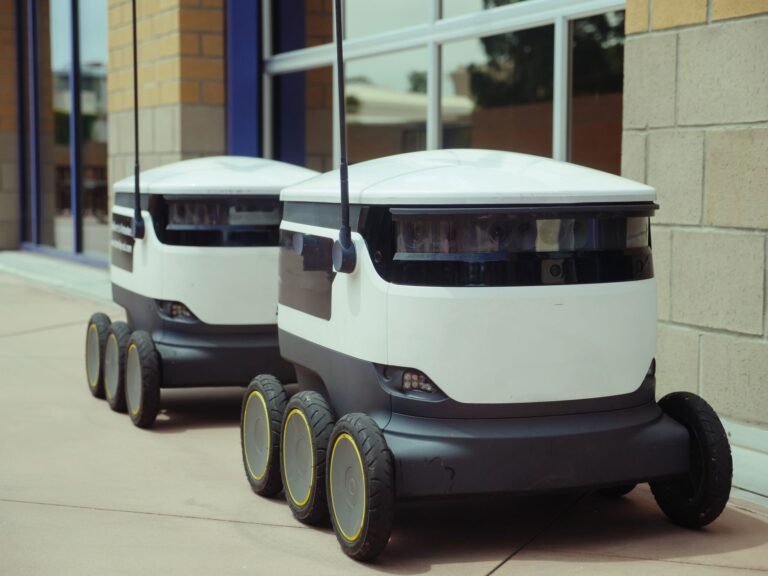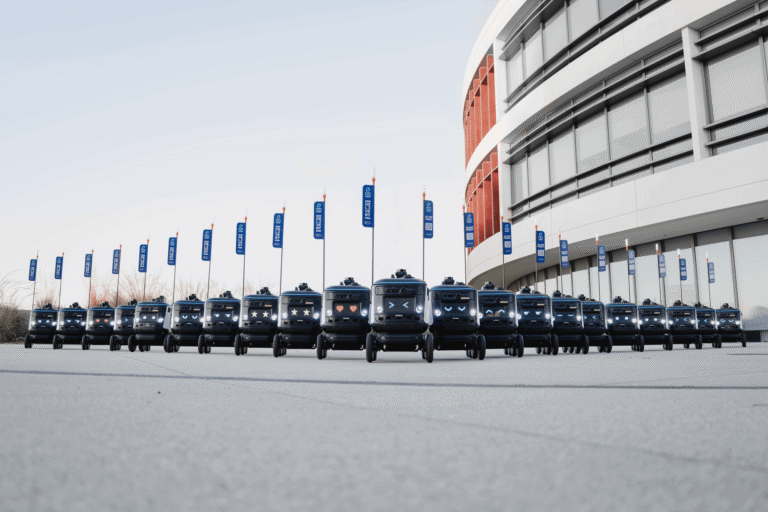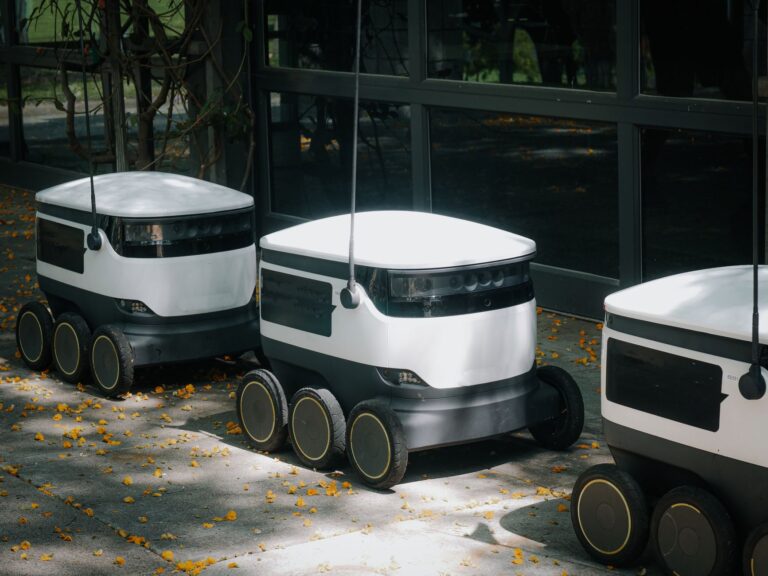

Nvidia is the next—and perhaps the only—company truly powering the autonomous systems revolution. The company has positioned itself not as a robotics manufacturer, but as the foundational technology provider for an entire industry shift toward what Jensen Huang calls “physical AI.” With the release of the Jetson T4000 module, powered by its Blackwell architecture, Nvidia has delivered 4x greater energy efficiency and AI compute compared to previous generations, addressing the fundamental constraint that has limited robotics deployment: the power budget required to run meaningful AI on mobile platforms. This isn’t theoretical—Boston Dynamics, Caterpillar, Franka Robots, Humanoid, LG Electronics, and NEURA Robotics have all debuted new robots built on Nvidia technologies, turning the company’s AI platform into the de facto operating system for physical machines. What separates Nvidia’s robotics strategy from past AI hype is the completeness of the stack.
The company isn’t selling one breakthrough; it’s selling an entire ecosystem from chips to software frameworks to foundation models. The Rubin Platform promises to deliver AI tokens at one-tenth the cost, while the GR00T N2 foundation model helps robots succeed at new tasks in new environments more than twice as often as leading vision language action models. These aren’t incremental improvements. They represent the infrastructure that will determine whether robotics becomes a trillion-dollar industry or remains a niche technology tied to specific, pre-programmed tasks.
Table of Contents
- How Nvidia Built the Hardware Foundation for Autonomous Robots
- The Foundation Models That Let Robots Learn Without Retraining
- Real-World Deployment: When Theory Becomes Manufacturing Reality
- The Software Ecosystem That Enables Rapid Development
- Autonomous Vehicles: The Ultimate Test Case for Physical AI
- The Economics of Scale That Drive Adoption
- Jensen Huang’s Vision and What It Means for Industrial Automation
- Conclusion
How Nvidia Built the Hardware Foundation for Autonomous Robots
The Jetson T4000 module represents a fundamental shift in how robotics companies approach compute. Previous generations of edge AI hardware forced developers into uncomfortable tradeoffs: accept power consumption that drains batteries in hours, or sacrifice the compute needed to run sophisticated AI models. The T4000’s 4x improvement in energy efficiency breaks that constraint. For a mobile robot operating in a warehouse, manufacturing facility, or autonomous vehicle, battery life isn’t a luxury—it’s a business metric. A robot that requires charging every four hours cannot be deployed at scale; one that runs a twelve-hour shift becomes economically viable. But raw efficiency alone doesn’t drive adoption. The Jetson platform matters because it’s become the reference architecture that robotics partners have optimized around.
Boston Dynamics, traditionally a roboticist’s robotics company focused on elegant mechanisms, is now embedding nvidia compute into its humanoid and legged platforms. Caterpillar, which operates heavy equipment across thousands of job sites, has chosen Nvidia to power autonomy in construction machinery. This isn’t random: partners choose Nvidia because the platform reduces their time-to-deployment and because the company’s investment in tooling and support means they’re not building autonomy infrastructure from scratch. The Rubin Platform amplifies this advantage by reducing the per-token inference cost of AI models to one-tenth of conventional approaches. For robotics companies, this shifts the economics of deployment. A system that costs ten cents per inference operation becomes impractical at scale; a system that costs one cent per inference becomes sustainable. This efficiency advantage compounds when you’re running a model millions of times per day across thousands of deployed units.
The Foundation Models That Let Robots Learn Without Retraining
Hardware is necessary but insufficient. The actual leap in robotics capability comes from GR00T N2, Nvidia’s next-generation foundation model trained on real robot interaction data. A foundation model in robotics works similarly to language models in NLP: rather than programming explicit rules for how a robot should pick up an object or navigate around an obstacle, the robot learns from patterns in vast datasets of successful robot behaviors. GR00T N2 succeeds at new tasks in new environments more than twice as often as competing vision language action models—a meaningful performance gap that translates directly to deployment feasibility. The difference between success rates matters more in robotics than in many other domains. A language model that’s 50% accurate might still be useful for brainstorming; a robot that’s 50% accurate at grasping objects in a warehouse fails to automate the job and becomes a liability.
GR00T N2’s 2x improvement in success rates on unfamiliar tasks means that robots can be deployed into new environments with less initial tuning and retraining. Cosmos, Nvidia’s reasoning model, extends this capability further by allowing robots to understand spatial relationships and predict outcomes before taking action. A robot equipped with these models can reason about whether a particular grasp approach will work or whether a different trajectory is required—moving closer to genuine autonomy rather than scripted behavior. The limitation worth acknowledging: foundation models in robotics remain domain-specific. A model trained primarily on manipulation tasks still struggles with locomotion challenges, and vice versa. Nvidia is releasing these as open models to encourage the community to develop task-specific variants, but that also means adopters need sophistication to know which model applies to their use case and how to fine-tune it effectively.
Real-World Deployment: When Theory Becomes Manufacturing Reality
The partnerships reveal where this technology is actually being deployed. Boston Dynamics is building humanoid robots designed for warehouse and logistics work—exactly the application where a robot that can learn new manipulation tasks without full retraining creates economic value. Franka Robots, focused on collaborative manufacturing, gains the ability to adapt to new production line configurations through on-device learning rather than factory-floor retraining. NEURA Robotics similarly benefits from models that understand natural language instructions, reducing the programming complexity required to deploy robots into new SME manufacturing operations. Caterpillar’s involvement signals something broader: heavy equipment autonomy. Construction sites are some of the most unpredictable environments robotics must operate in.
Weather conditions change, terrain is irregular, human workers are present and unpredictable. A foundation model trained on diverse equipment behaviors can generalize better to new sites and conditions than a hand-coded system. This is where GR00T N2’s 2x success rate advantage becomes a business case rather than a benchmark: it’s the difference between a deployed fleet that actually works and a pilot program that never scales. LG Electronics’ involvement in this ecosystem signals the residential robotics direction—vacuum robots, delivery robots, and maintenance robots that must adapt to novel home environments. This application area showcases both the promise and the limitation of foundation models. A robot must generalize across millions of different home layouts, furniture arrangements, and obstacles. GR00T N2 enables this generalization, but it still requires homeowners to have consistent broadband connectivity if cloud inference is involved, or substantial onboard compute if everything runs locally.

The Software Ecosystem That Enables Rapid Development
Hardware and models mean nothing without the tools to integrate them. Isaac Lab-Arena provides a robot evaluation framework that lets developers test behaviors in simulation before deployment. OSMO functions as an edge-to-cloud framework for training workflows—critical for the robotics workflow where a robot collects interaction data in the field, that data is shipped to cloud systems for model improvement, and updated models are deployed back to the edge. This closed-loop learning capability is what separates one-off robots from fleets that improve over time. The development ecosystem parallels what made Nvidia dominant in AI research: tools that compress the time between idea and deployment. A researcher or engineer can use Isaac Lab-Arena to evaluate whether a particular control approach works, OSMO to handle the training pipeline, and Jetson T4000 to deploy it—all from a single company.
This vertical integration creates switching costs. Once a robotics team has built training pipelines in OSMO and evaluation frameworks in Isaac Lab-Arena, migrating to a competitor’s toolchain means rebuilding everything. This is how platform dominance in technology typically persists: not through superior marketing but through the friction of migration. The tradeoff here is vendor lock-in. Teams betting on Nvidia’s robotics stack gain speed to deployment but reduce their optionality for using alternative hardware or software later. For companies betting on robotics as core to their business model, this is often an acceptable tradeoff; for smaller teams, it’s a risk.
Autonomous Vehicles: The Ultimate Test Case for Physical AI
Nvidia’s most ambitious deployment target is autonomy in transportation. The company is targeting 2027 for robotaxi deployment using its AI chips and Drive AV software to achieve “Level 4” autonomy—vehicles capable of driving without human intervention in pre-defined regions like dense urban environments or airport shuttles. This is not the consumer self-driving dream that Elon Musk has been promising for a decade; it’s a more constrained, more realistic goal that acknowledges the genuine technical difficulty of full autonomy. What matters about the 2027 target is not whether it’s achieved on schedule but what it signals about the maturity timeline for physical AI. A robotaxi operating in a defined service area must handle countless edge cases—pedestrians at unexpected angles, weather conditions that confuse cameras, infrastructure that varies by city. These challenges aren’t solvable through incremental sensor improvements or more processing power alone.
They require the foundation model approach that GR00T and related Nvidia models represent: systems that learn from diverse real-world data rather than being hand-coded for every scenario. The critical limitation here is operational domain. Level 4 autonomy in a robotaxi works within defined geographic boundaries and operational conditions. A robotaxi designed for San Francisco cannot simply be deployed in Boston or Tokyo without adaptation work. This constraint—that even the most sophisticated autonomous systems require localization and operational retuning—applies across all physical AI applications. A robot optimized for one warehouse configuration struggles in a different facility with different equipment layout.
The Economics of Scale That Drive Adoption
The Rubin Platform’s promise of one-tenth token cost matters because robotics economics are severely constrained by operational expense. A manufacturing robot that costs ten times more to operate in inference compute than in mechanical components is uneconomical. Industrial adoption requires the inference cost to be a small fraction of the total value delivered.
By reducing token costs to one-tenth, Rubin removes a major barrier to large-scale deployment. Consider a fleet of 1,000 autonomous loaders in construction: each running hundreds of inference operations per day across a six-year operational life. The difference between one-cent and ten-cent token costs is hundreds of thousands of dollars across the fleet lifecycle—easily enough to justify choosing Nvidia’s platform over alternatives or justifying the capital expense of the robots themselves. This is how platform technologies achieve dominance: not through technical perfection but through the economics of scale that make alternatives uncompetitive.
Jensen Huang’s Vision and What It Means for Industrial Automation
Jensen Huang’s statement that “physical AI has arrived—every industrial company will become a robotics company” captures the ambition underlying Nvidia’s robotics strategy. This isn’t a prediction that factories will be full of humanoid robots in five years. It’s a recognition that the barrier to deploying autonomous systems in industrial processes has dropped low enough that companies in every sector will adopt them. A logistics company becomes a robotics company when it deploys autonomous loaders. A manufacturer becomes a robotics company when assembly lines incorporate collaborative robots that learn new tasks. A construction firm becomes a robotics company when it operates autonomous dozers and excavators.
This vision is plausible precisely because Nvidia is not building the robots themselves. The company is providing the infrastructure that allows specialized roboticists and equipment manufacturers to add autonomy to their products. Boston Dynamics brings expertise in legged locomotion. Caterpillar brings decades of experience in construction equipment. LG brings consumer product sophistication. Nvidia provides the common foundation—the chips, models, and development tools—that makes autonomy feasible across all these domains.
Conclusion
The next Nvidia in robotics is Nvidia itself. By establishing dominance not in robot manufacturing but in the foundational compute and software stack that all robotics companies build upon, Nvidia has created a position that’s difficult to dislodge. The Jetson T4000’s efficiency, GR00T N2’s learning capability, and the complete development ecosystem from OSMO to Isaac Lab-Arena create switching costs that favor consolidation around the Nvidia platform. What comes next is not innovation in robotics technology—that will continue to come from specialized robotics companies, equipment manufacturers, and research labs.
What comes next is adoption at scale. Companies like Caterpillar, Boston Dynamics, and NEURA Robotics will prove out deployment models in their domains. Those successes will motivate other industrial companies to enter robotics. And Nvidia’s platform, with its established lead in compute efficiency and foundation models, will be the default choice for the vast majority of those deployments. That’s not a prediction about robotics; it’s a pattern from Nvidia’s history in GPU computing and AI, playing out once more in the physical world.