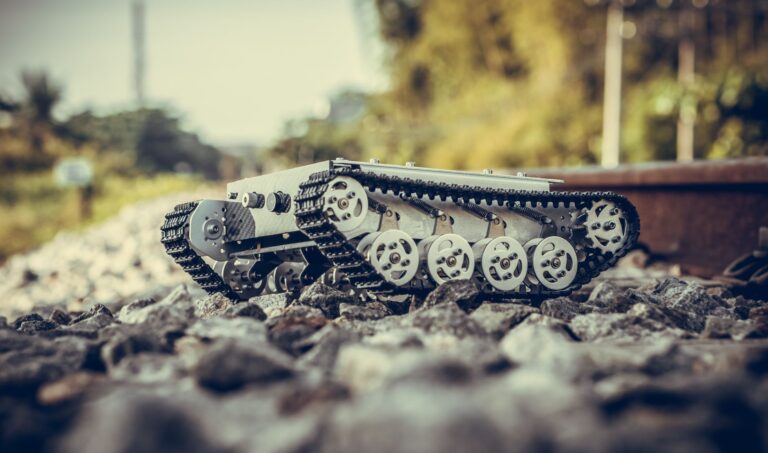

Robot demolition equipment means remote-controlled machines that break, cut, and remove concrete while the operator stands elsewhere. They improve site safety by separating people from falling debris, unstable floors, dust, and vibration at the breaker point. Typical units are compact, electric, and guided by radio remote or video. That combination suits confined interiors, hospitals, tunnels, and upper floors where diesel machines cannot work safely.
Table of Contents
- How far can operators stand back?
- Where do compact electric robots work best?
- What health risks does distance lower?
- What safety steps remain mandatory?
- Frequently Asked Questions
How far can operators stand back?
Husqvarna Construction, reported by Canadian Rental Service, rates its DXR robots for operation from up to 300 meters away in Husqvarna DXR range announcement. That distance lets operators stay clear of falling debris, unstable ground, and confined zones. Brokk, reported by Concrete Products, positions mobile robots up to 300 meters from the crew in Brokk breakwater safety report.
Larger pedestal-boom versions can run from a control room up to 2,000 meters away with video monitoring. Distance is a control, not a guarantee. Operators still need clear sightlines or cameras and defined exclusion zones. Crews should agree on stop commands and a safe machine state if signal drops.
Where do compact electric robots work best?
KHD Brokk Hire reports that Brokk and Husqvarna electric robots produce zero exhaust emissions in KHD Brokk Hire safety overview. They can work in hospitals, occupied buildings, tunnels, and poorly ventilated spaces where diesel fumes create hazards. Rental Equipment Register notes the Brokk 160 measures 4.1 feet high and 2.6 feet wide.
Models such as the Brokk 70 and Brokk 160 fit through standard doorways. They can operate on upper floors, basements, and tight interiors beyond the reach of larger excavators. Check access and support before choosing a model. Confirm floor capacity, lift limits, power supply, and cable routing.
- measure doorways, turns, lifts, and floor loads on the travel path
- route power cables away from falling material and traffic
- separate occupied rooms from noise, dust, and haul routes
What health risks does distance lower?
The NIOSH Mining Program links remote operation to less exposure at the breaker point. Operators avoid hand-arm vibration, heavy dust, and cab strike hazards. Nearby workers also gain from greater separation from whole-body vibration, silica, and noise. OSHA limits respirable crystalline silica to 50 micrograms per cubic meter as an 8-hour average, with a 25-microgram action level, according to the eLCOSH summary of 29 CFR 1926.1153 in eLCOSH summary of the OSHA silica standard.
Remote distance must supplement water, ventilation, and respirator controls during concrete breaking. It does not replace them. Treat dust control as a layered system. Use water at the attachment, ventilate the room, monitor exposure, and select respirators for the task.
What safety steps remain mandatory?
OSHA construction standard 29 CFR 1926.850(a) requires an engineering survey before demolition starts, according to the OSHA Demolition Standards page. A competent person must assess framing, floors, walls, and collapse risk. Failures in this survey step account for up to 75 percent of demolition-site citations. OSHA has no robot-specific regulation.
An analysis published by EHS Today and Seyfarth Shaw says employers must use job-hazard analyses for robotic equipment. Those analyses must address radio-frequency interference, loss-of-signal behavior, and hazardous-energy lockout. Write the robot into the demolition plan and permits. Define remote stations, exclusion zones, communication checks, interference sources, fail-safe settings, and lockout steps for tool changes and maintenance.
Frequently Asked Questions
Can a demolition robot replace silica dust controls?
No. Distance lowers exposure at the breaker point, but crews still need water, ventilation, exposure monitoring, and respirators under the OSHA silica standard.
Can these robots work inside occupied buildings?
Yes, when planned carefully. Electric models produce zero exhaust emissions, and compact models fit doorways and upper floors, but crews must manage noise, dust, power cables, and exclusion zones.
What is the main regulatory gap for robot demolition?
OSHA has no robot-specific rule. Employers must run job-hazard analyses covering signal loss, radio interference, and lockout during setup, operation, and tool changes.