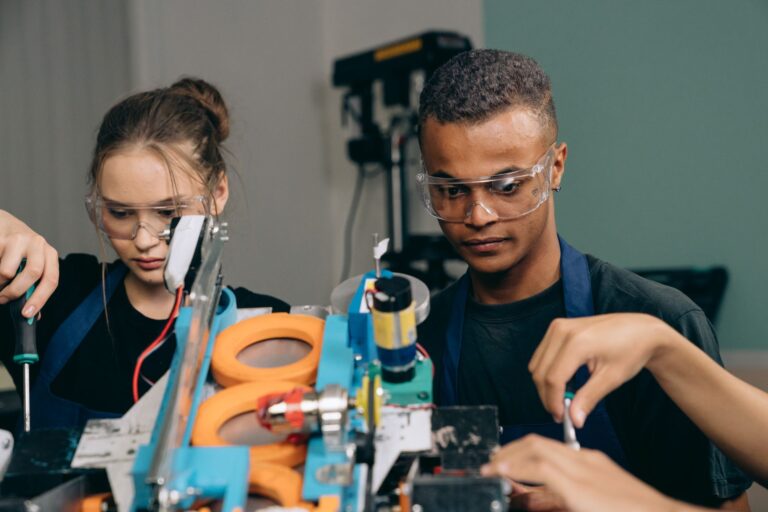

Lakeshore Public Schools in Stevensville, Michigan, is getting a dedicated robotics building: an "LEF Robotics & Professional Development Center" estimated at $500,000 and targeted to open for the 2028-29 school year. For the district, it means its existing FIRST and LEGO League teams move out of borrowed gym space and into a building with a regulation competition field, design space and meeting rooms of their own. It is also privately funded. The Herald-Palladium reported that the center is the largest of four projects announced by the Lakeshore Excellence Foundation, a local education foundation that already underwrites district programs — so no bond issue, no millage and no public vote stand between the announcement and the build.
Table of Contents
- What the building actually contains
- Who pays, and why that changes the timeline
- The limits of what has been decided
- What it means for students now in the district
- The hosting case, which is the underrated part
- Frequently Asked Questions
What the building actually contains
The center's defining feature is a regulation FIRST competition field. FIRST is the international robotics competition organization whose high school program, FRC, runs on a field roughly 27 by 54 feet with a game that changes annually. A regulation field is the difference between a team practicing against a taped outline on a gym floor and a team practicing against the real thing.
Alongside the field, the Herald-Palladium reported the building will hold design and meeting space, and will serve as the designated home of the district's LEGO League program. FIRST LEGO League is the elementary and middle school tier — smaller robots, a tabletop mat, a research project component — and it is the feeder that keeps a high school team stocked. Putting both tiers under one roof matters more than it sounds. A nine-year-old who competes in the same building the varsity team builds in has a visible path forward, and mentors can move between tiers without moving across campus.
Who pays, and why that changes the timeline
The four projects come out of a $750,000 commitment the Lakeshore Excellence Foundation board approved on the evening of Tuesday, Oct. 6, 2026, according to Harbor Country News. Superintendent Greg Eding and his administration proposed them; the LEF board approved them. The other three fund teacher training, inclusive athletics and classroom emergency preparedness.
The scale is worth sitting with. LEF's Form 990 filing for fiscal 2024 reports $738,000 in revenue and $682,302 in grants paid to Lakeshore Public Schools that year. A $500,000 building is therefore close to an entire year of the foundation's giving, which is the clearest signal that the cost will be spread across multiple fiscal years rather than written in one check. That is also the honest explanation for a 2028-29 opening on a project announced in 2026. Foundation-funded construction moves at the speed of fundraising, not at the speed of a bond sale that delivers cash up front.
The limits of what has been decided
The site is planned near Lakeshore High School's career and technical education programs, but Harbor Country News reported the exact location had not been finalized when the projects were announced. No footprint and no construction schedule are fixed yet.
For anyone tracking this, that is the gap between an approved budget and a shovel. Things that remain open at this stage typically include: None of that undermines the commitment. It does mean the published $500,000 is an estimate attached to a concept, and estimates attached to concepts move when a site is chosen.
- Square footage, which sets whether the design space fits one robot or three
- Whether the field sits in a dedicated high bay or shares a flexible room
- Utility and power capacity, which governs machining and fabrication tools
- Spectator capacity, which determines what size event the building can host
- A bid and construction calendar, which is what makes 2028-29 firm or soft
What it means for students now in the district
Lakeshore enrolled 2,635 students across its K-12 buildings in 2024-25, per NCES figures summarized on Wikipedia. Spread across that enrollment, the center works out to roughly $190 per currently enrolled student — a useful benchmark for anyone comparing this against a district's own capital wish list. The timing sorts students into two groups. Current Lakeshore sixth-graders are the youngest cohort certain to use the building as high schoolers, since they reach ninth grade as it opens.
Students in grades seven through twelve today get partial use or none, which is the ordinary arithmetic of any multi-year school facility. Importantly, nobody is waiting on the building to start. LEF already funds the district's robotics pipeline, including the high school FIRST team "Lance-A-Bot" and the elementary-level Lancer-Bot-Mania competition. The hub consolidates programs that run today; it does not create them.
The hosting case, which is the underrated part
Lakeshore High School already hosts outside FIRST LEGO League teams — a Buchanan District Library team competes there on Nov. 22. That means the district is currently a regional venue that converts a gym to do the job, then converts it back. A permanent field removes the conversion.
Setup and teardown for a competition field is the single largest logistical cost of hosting, and it is why most districts host once a season rather than regularly. A building designed for it can run scrimmages, off-season events and practice matches for neighboring programs year-round. For nearby teams without facilities, that is the tangible benefit outside Lakeshore's own enrollment. The practical thing to watch is whether the final design includes spectator seating and pit space, because those two choices decide whether the building hosts official district-level FRC events or stays a practice and LEGO League venue.
Frequently Asked Questions
Did voters approve the $500,000 robotics center?
No. The Herald-Palladium reported that Superintendent Greg Eding and his administration proposed the projects and the Lakeshore Excellence Foundation board approved them. It is private foundation money, not a bond issue or millage, so it required no public vote.
Where exactly will the building go?
It is planned near Lakeshore High School's career and technical education programs, but Harbor Country News reported the exact location had not been finalized when the projects were announced.
What are the other three LEF projects?
The $750,000 commitment also funds teacher training, inclusive athletics and classroom emergency preparedness, according to Harbor Country News.