
The next dominant player in robotics may not come from perfecting humanoid mechanics or autonomous navigation algorithms. Instead, it could emerge from solving an unglamorous but critical problem: how to run sophisticated AI on robots without requiring massive, centralized compute infrastructure. Edge computing—processing data locally on the robot itself rather than sending it to the cloud—is becoming the architectural foundation of next-generation robotics, and companies that deliver efficient, specialized silicon for edge AI could capture the kind of market dominance that Nvidia has enjoyed in data centers. The robotics industry is at an inflection point where the bottleneck is no longer dreaming up what robots should do, but building the hardware substrate that lets them do it reliably, affordably, and independently.
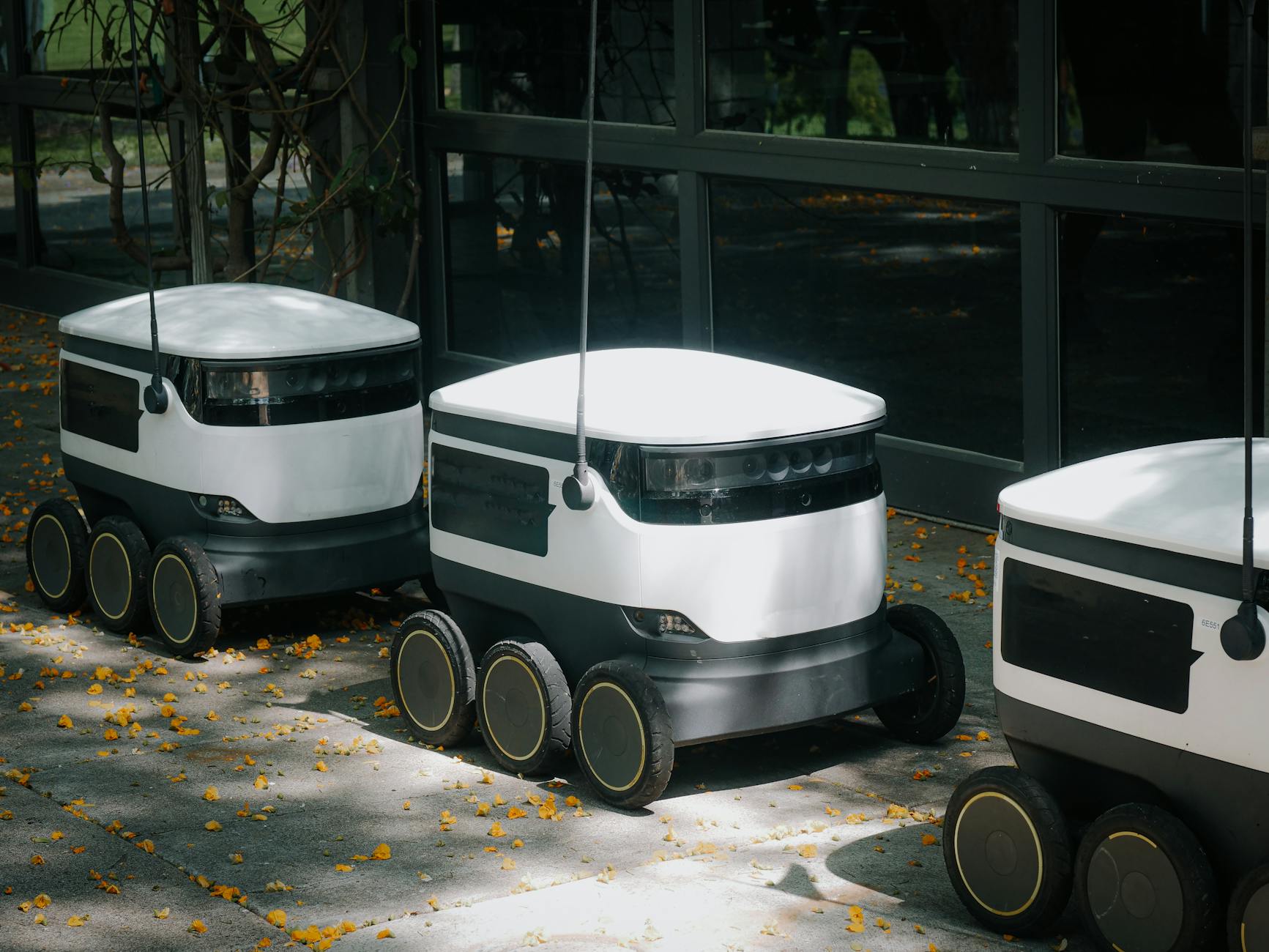
Consider the Serve Robotics platform that debuted at NVIDIA GTC 2026. Their new conversational robot, Maggie, relies on edge computing integrated with 5G Advanced connectivity to operate in real-world environments without constant cloud connectivity. This represents a fundamental shift: successful robotics companies will be those that can deploy intelligence at the point of action, not just send terabytes of sensor data upstream. The companies that control the silicon stack enabling this shift—processors, memory architectures, and AI acceleration platforms optimized for edge robotics workloads—stand to capture extraordinary value.
Table of Contents
- Why Edge Computing Is Becoming the Robotics Industry’s Critical Bottleneck
- The Chipmakers Competing for Edge Robotics Dominance
- Strategic Partnerships Reshaping Industry Architectures
- The Power and Thermal Realities Constraining Robotics Design
- The Real-World Deployment Challenge That Many Underestimate
- The Industrial Robotics Upgrade Cycle and Market Opportunity
- The Emerging Winner Might Not Be a Semiconductor Company at All
- Conclusion
Why Edge Computing Is Becoming the Robotics Industry’s Critical Bottleneck
For decades, robotics manufacturers assumed that sophisticated AI required centralized processing. Send the sensor data to a data center, run inference on powerful GPUs, send the command back to the robot. The problem is latency, reliability, and cost. A robot in a factory floor waiting for cloud round-trips cannot respond quickly to unexpected obstacles or changing conditions. A robot deployed where bandwidth is constrained or unavailable becomes useless. And the cost of perpetual cloud compute for millions of robots becomes economically unviable. Edge computing flips this model: the robot becomes its own intelligence center, processing decisions locally with assistance from cloud systems only when beneficial.
The market tailwind is substantial. The global edge computing market is projected to grow at a compound annual growth rate of 13.8%, reaching $380 billion by 2028. This isn’t abstract infrastructure investment—it’s the physical substrate on which the next decade of robotics will operate. Industrial robotics leaders including ABB, FANUC, KUKA, and Yaskawa have installed over two million robots globally, and virtually all of them require upgrades to edge AI capabilities to remain competitive in autonomous applications. What makes this opportunity so significant is that edge computing for robotics is not a single product, but an entire ecosystem of specialized silicon. Traditional processors designed for general computing or even smartphone AI are inefficient at the specific workloads robotics demands: real-time 4K video processing, simultaneous multi-sensor fusion, low-latency decision-making under power and thermal constraints. Companies that design silicon specifically for these constraints, rather than adapting general-purpose chips, will capture the highest margins and customer loyalty.

The Chipmakers Competing for Edge Robotics Dominance
Several semiconductor companies are now explicitly targeting the edge robotics opportunity, and none of them are household names in the way Nvidia is for gaming or data centers. Qualcomm signaled a major strategic commitment by announcing a long-term collaboration with NEURA Robotics in March 2026 to advance next-generation robotics and physical AI platforms. this wasn’t a casual partnership—it reflects Qualcomm’s conviction that the robotics edge market is significant enough to warrant dedicated product lines and engineering resources. Separately, Qualcomm launched the Dragonwing IQ10 processor at CES 2026 as a power-efficient alternative for robotics applications, explicitly designed to deliver capable AI performance without requiring 2,000 teraflops of compute that larger processors demand. This targeting matters: most robotics applications don’t need the sledgehammer of a datacenter GPU, and companies deploying thousands of robots care deeply about power consumption and heat dissipation. Ambarella presents another compelling case study.
The company has shipped approximately 30 million AI processors to date, with over 70% of current revenue derived from edge AI applications. Ambarella has largely flown under the radar compared to Nvidia, yet it has built a defensible market position by specializing in video processing and edge AI—precisely the capabilities that mobile and stationary robots require. Their track record suggests that capturing 20-30% of a niche market through focused engineering can generate Nvidia-scale valuations, especially if that niche is growing at double-digit rates. Synaptics is actively sampling silicon for pilot humanoid robot builds with a major North American robotics company, with deliveries scheduled by the end of 2026. The fact that humanoid robot developers are integrating Synaptics silicon into their pilots indicates that traditional Nvidia offerings are not optimal for these applications, creating an opening for specialists. A limitation to watch: these partnerships are still in pilot phase, and pilot success does not guarantee market adoption. Many specialized chips have shown promise in controlled environments only to struggle with production scaling or cost-competitive manufacturing.
Strategic Partnerships Reshaping Industry Architectures
The most revealing indicator of where the robotics industry is headed comes from examining which companies are partnering with whom. NVIDIA, despite its dominance, is deepening collaboration with QNX rather than simply selling Jetson products. QNX and NVIDIA announced that they are integrating QNX OS for Safety 8.0 with NVIDIA DRIVE AGX Thor, extending beyond automotive into robotics and industrial edge systems. This partnership indicates that neither company alone has the complete solution—Nvidia has the compute, but QNX brings the safety-critical software architecture that industrial robotics demands. Meanwhile, Nvidia is also promoting the Jetson T4000, which offers up to 1,200 FP4 TFLOPs of AI compute, 64 GB of memory, and real-time 4K video processing capability.
The Jetson T4000 is not a consumer-grade processor; it’s purpose-built for robotics and edge AI applications. That Nvidia is investing in this segment suggests they recognize that datacenter GPUs are not the optimal solution for deployed robotics, and specialized edge silicon will command premium positioning. The warning embedded in this ecosystem shift is that no single company appears to be winning decisively. Instead, the industry is fragmenting into specialized niches: Qualcomm for wireless-connected robotics, Ambarella for video-heavy applications, Synaptics for humanoid projects, and Nvidia for high-performance robotics requiring maximum compute density. This fragmentation might indicate that the winner will be whoever controls the software abstraction layer that sits above these diverse chips, rather than the chip manufacturers themselves.

The Power and Thermal Realities Constraining Robotics Design
One of the most underappreciated technical constraints in robotics is power consumption. A mobile robot or humanoid robot operating on batteries cannot afford to dissipate kilowatts of power, yet traditional AI inference on high-end GPUs does exactly that. Edge computing specialists understand this constraint viscerally in ways that datacenter-focused companies sometimes don’t. The Dragonwing IQ10’s explicit design goal—delivering capable AI without massive thermal output—reflects a fundamental tradeoff that shapes the entire competitive landscape. Consider the comparison: a full-size Nvidia H100 GPU consumes up to 700 watts. A robot carrying such a device would need a massive battery pack, limiting payload capacity, runtime, and practical deployments.
By contrast, the Jetson T4000 operates within much tighter power envelopes, making it viable for robotics. But even the T4000 may be overkill for many applications. The Qualcomm Dragonwing IQ10 represents a different point on the performance-power curve: lower absolute performance, but sufficient for most robotics tasks while consuming far less energy. This tradeoff explains why multiple competitors can coexist profitably in edge robotics—they are optimizing for genuinely different applications with different constraints. The practical implication is that robots optimized for one chipmaker’s architecture may not easily migrate to another’s. Software stack compatibility, driver support, and optimization matter enormously. Companies like Qualcomm partnering with NEURA Robotics and Synaptics working with humanoid manufacturers are betting that they can lock in customers early by providing superior software integration and reliability for their specific hardware.
The Real-World Deployment Challenge That Many Underestimate
Moving from pilot projects to factory-floor deployment exposes numerous technical and business challenges that silicon specs don’t capture. The Serve Robotics deployment at NVIDIA GTC showcasing Maggie relied not just on edge AI but also on 5G Advanced connectivity as a fallback mechanism. This reveals an important limitation: even companies betting on edge computing still maintain cloud connectivity as a safety net for complex decisions, periodic model updates, and operational oversight. The “edge” is not actually fully disconnected from the cloud; it’s more accurately described as a hybrid architecture where edge handles real-time decisions and cloud provides oversight and learning. Another real-world constraint is software ecosystem maturity. Industrial robotics companies like FANUC and ABB operate legacy ecosystems built over decades. These robots cannot simply have new processors dropped in and expected to work.
The software must be compatible, the programming interfaces must align, and most critically, the safety certifications must be maintained. A new chip architecture requires re-certification, re-testing, and re-qualification before it can be deployed in regulated industrial environments. This regulatory moat actually works in favor of established players like Nvidia, who have already invested in these certifications. The supply chain risk is also material. Ambarella’s success with 30 million shipped processors gives them manufacturing credibility, but any new entrant relying on specialized silicon faces single-source vulnerability. If a chip manufacturer’s fabrication partner encounters supply constraints or production issues, a robot company dependent on that specific processor faces potential production halts. Qualcomm’s partnership strategy appears designed to mitigate this by embedding edge robotics into their broader semiconductor roadmap, ensuring sustained manufacturing priority.

The Industrial Robotics Upgrade Cycle and Market Opportunity
The installed base of over two million industrial robots from ABB, FANUC, KUKA, and Yaskawa represents both a challenge and an opportunity. These robots are capital equipment with 10-20 year operating lifespans. Retrofitting them with edge AI capabilities is not a simple software update; it often requires hardware integration, which creates an upgrade cycle.
However, this also means that companies providing edge AI retrofit solutions and supporting silicon stand to benefit from replacement demand as older robots reach end-of-life. A specific example illustrates the dynamics: FANUC’s CRX collaborative robots, designed for factories where humans and robots work alongside each other, increasingly require real-time computer vision and decision-making to operate safely without extensive hardcoded programming. These requirements push FANUC toward more capable edge processors and specialized silicon. Companies providing the silicon for next-generation collaborative robots position themselves as essential infrastructure partners rather than commodity suppliers.
The Emerging Winner Might Not Be a Semiconductor Company at All
As the robotics industry matures, the companies that own the integration layer may win more decisively than chip vendors competing in commoditizing edge processors. Notice that QNX is partnering with Nvidia rather than competing; this positions QNX as the essential software abstraction layer between diverse hardware and robotics applications. Similarly, middleware platforms that abstract away specific chip differences may capture more value than any individual semiconductor vendor.
Looking forward to 2027 and beyond, expect consolidation among edge AI chip specialists, expanded partnerships between traditional robotics companies and semiconductor firms, and increasing emphasis on heterogeneous computing—mixing different specialized processors within a single robot to optimize for different workloads. The company that figures out how to make this heterogeneous computing transparent to robotics engineers will likely capture the most value. Whether that company is Qualcomm, Ambarella, Nvidia, or a software company that hasn’t yet emerged remains an open question.
Conclusion
The next Nvidia in robotics very likely will be an edge computing play, but not in the way traditional semiconductor analysis might suggest. Rather than a single company dominating with a universal solution, the robotics industry appears to be fragmenting into specialized niches where companies like Qualcomm (power-efficient general robotics), Ambarella (vision-heavy applications), and Synaptics (humanoid specialists) each capture defensible positions. The common thread is not dominance but specialization—solving real constraints that datacenter-oriented processors ignore. The real opportunity for investors and customers is understanding that this fragmentation is a feature, not a bug.
It means the robotics industry is sufficiently large and diverse that multiple approaches can prosper simultaneously. Companies building edge AI solutions for robotics should focus on solving specific robotics problems with hardware and software optimized for those problems, rather than adapting general-purpose solutions. The next era of robotics profitability will flow to companies that understand their constraints deeply—power, latency, safety, thermal management, and regulatory compliance—and design silicon and software specifically to address them. The winner might be Qualcomm or Synaptics or an entirely new entrant, but it will almost certainly be someone who is obsessed with the edge.