
The bull case for Rockwell Automation stock rests on a straightforward thesis: the company sells the technology that makes American factories economically viable at scale. As US manufacturing reshoring accelerates—driven by eroding labor arbitrage with offshore production—Rockwell stands to capture disproportionate growth because factory owners need their platforms to compete. Morgan Stanley raised its price target to $525 in May 2026, and the company just guided earnings up 8% for fiscal 2026, signaling confidence that demand is only beginning. The factory automation market itself is growing at roughly 11.9% annually, projected to expand from $310 billion in 2025 to $347 billion in 2026, with long-term forecasts reaching $632 billion by 2034.
What makes this more than cyclical optimism is the specificity of the catalyst: Rockwell doesn’t just sell hardware anymore. The company has woven AI-driven engineering workflows into its factory design process, cutting deployment time and complexity. This shifts revenue from one-time capital projects to recurring software subscriptions, which command higher multiples and offer more predictable cash flow. Combined with the structural reshoring tailwind and record manufacturing capital expenditures, the scale of the addressable market is fundamentally larger than it was five years ago.
Table of Contents
- How US Reshoring Is Remaking the Factory Automation Market
- Market Growth Trajectories and the Scale Opportunity
- AI-Driven Automation as the New Demand Layer
- The Switching Cost Moat and Ecosystem Lock-In
- Financial Performance and Forward Guidance
- Data Center Automation and Emerging Verticals
- The Real-World Mechanics of Factory Automation Scale
How US Reshoring Is Remaking the Factory Automation Market
The reshoring narrative hinges on a simple economic reality: offshore labor cost advantages have narrowed sharply. Morgan Stanley’s $10 trillion US reshoring thesis assumes labor arbitrage—the main reason manufacturing fled to Asia—is no longer the decisive factor. When factories can’t compete purely on wage advantage, they compete on speed, flexibility, and advanced technology. That’s where Rockwell’s platform becomes essential. A semiconductor fab or automotive assembly plant built in the US today must maximize throughput and minimize waste to justify higher domestic labor costs. The company’s Logix controllers and FactoryTalk ecosystem provide the real-time optimization and predictive maintenance that make that possible. The market momentum backs this up.
US industrial machinery orders rallied roughly 50% since “Liberation Day” (the Trump administration’s policy pivot), according to Morgan Stanley’s research. This isn’t speculative or policy-dependent—it’s actual order data. Rockwell’s Q2 fiscal 2026 results show organic sales growth accelerated to 9%, up from 3% in Q1, and the company specifically cited strength in industrial automation and digital transformation projects. One example is warehouse automation, where e-commerce fulfillment demands have forced major retailers to deploy thousands of robotic arms and conveyor systems, nearly all of which run on Rockwell or compatible controllers. The risk here is policy reversal. If reshoring incentives fade or tariffs are reduced, capital spending could cool. Additionally, overseas competitors—particularly Siemens in Europe and emerging Chinese automation vendors—are improving product quality and driving prices down in emerging markets. Rockwell’s dominance in North America is less assured globally, and international revenue faces currency headwinds and local competition that don’t affect domestic-focused manufacturers.
Market Growth Trajectories and the Scale Opportunity
The raw market-size numbers are staggering. Industry analysts project factory automation spending to grow from $310 billion globally in 2025 to $347 billion in 2026—a 12% jump—with compounded annual growth reaching 11.9%. Alternative forecasts are even more bullish, predicting the market will reach $505 billion by 2031 and $632 billion by 2034. These aren’t theoretical extrapolations; they’re grounded in specific demand vectors: rising robot density in manufacturing, expanding industrial software revenues, record manufacturing capex, and proliferating AI-driven production systems. Within that broader market, software is the faster-growing segment. Industrial automation software alone is projected to expand from $40.83 billion in 2025 to $43.87 billion in 2026, and reach $62.9 billion by 2031—a 9.4% compound annual growth rate. This is where Rockwell’s strategic shift matters most.
The company has been systematically moving upmarket from discrete hardware sales into software-as-a-service offerings, predictive analytics platforms, and lifecycle services. When a factory buys a control system for $500,000, Rockwell books revenue once. When that same factory signs a three-year software subscription for predictive maintenance and production optimization running on Rockwell’s cloud infrastructure, the company books recurring revenue, higher margins, and built-in customer stickiness. One limitation to this bullish narrative: market growth projections often underestimate adoption friction. Factories are notoriously conservative about replacing working control systems, and the switching cost from an incumbent platform can be prohibitive. A 20-year-old assembly line running Rockwell hardware from 2004 won’t be ripped out and replaced just because new AI-enabled alternatives exist. So while aggregate market growth may hit 11%, Rockwell’s growth rate may depend on the mix of new greenfield projects versus retrofit work on legacy systems.
AI-Driven Automation as the New Demand Layer
In May 2026, Rockwell unveiled a significant product initiative at Hannover Messe: an AI-orchestrated industrial automation engineering workflow that simplifies factory design and cuts engineering time. This isn’t marketing speak. The workflow automates the process of translating a factory owner’s production goals into controller logic, safety interlocks, and supply-chain optimization. Instead of hiring a team of engineers to spend three months designing a new production line, a factory can input specifications into the AI system and deploy code in weeks. The implications are profound for Rockwell’s addressable market: factories that previously couldn’t justify the engineering cost of switching to a new control platform now can. The AI initiative is also driving demand for recurring software revenue, which was an explicit analyst focus in Q2 earnings. Semiconductor fab buildouts, automotive assembly plants, and warehouse automation projects are increasingly taking the full suite of Rockwell’s offerings—not just the hardware controller but the design software, the cloud-based analytics platform, the predictive maintenance modules, and the compliance and safety management tools.
These stack into subscription contracts that renew annually, creating revenue visibility and reducing customer churn. Data center automation, a segment that saw over 100% year-over-year growth in Rockwell’s fiscal Q2 2026, exemplifies this trend: hyperscale cloud operators are deploying Rockwell systems to manage cooling, power distribution, and equipment lifecycle at scale. The warning: AI automation workflows are improving competitor products as well. Siemens, ABB, and emerging vendors are developing similar AI-assisted engineering tools. The competitive advantage isn’t permanent—it’s eroding as the technology commoditizes. Rockwell’s edge is execution speed and ecosystem depth, not exclusive technology. Additionally, the AI manufacturing workflows require clean data and well-documented factory specifications, which many legacy facilities don’t have. So adoption, while growing, isn’t automatic or friction-free.
The Switching Cost Moat and Ecosystem Lock-In
Rockwell’s competitive position rests substantially on switching costs and ecosystem lock-in. The Allen-Bradley Logix platform and FactoryTalk ecosystem are the de facto standard in North American industrial automation. A factory that has 500 Logix controllers deployed across 50 lines, with hundreds of engineers trained on FactoryTalk, and with years of custom code and integrations built into the system, faces genuine economic friction in switching to a competing platform. The retraining cost, the integration testing, the code migration risk—these easily run into the millions for a large manufacturing operation. This switching cost advantage is reinforced by Rockwell’s scale and service depth. The company operates in over 100 countries with 27,000 employees, and its Lifecycle Services segment provides not just spare parts but digital consulting, asset management optimization, and production efficiency services. A competitor can match Rockwell’s hardware features; it’s much harder to replicate that service network and consulting capability overnight.
Additionally, Rockwell holds thousands of active patents in motion control, safety systems, and industrial cybersecurity. These don’t create absolute barriers—competitors can design around them—but they do slow competitive encroachment. The limitation is geographic. This moat is strongest in North America and parts of Europe. In China and Southeast Asia, local competitors and lower-cost vendors have eroded Rockwell’s pricing power, and the company competes more on feature and brand than on ecosystem lock-in. Furthermore, the shift toward modular, cloud-based architectures (rather than proprietary closed systems) is gradually reducing switching costs. If a factory can run production management software on cloud-agnostic infrastructure and swap out hardware modules more easily, the historical lock-in weakens. Rockwell’s management is aware of this shift and is investing heavily in open standards and cloud flexibility, but the transition is ongoing and creates near-term competitive risk.
Financial Performance and Forward Guidance
Rockwell’s Q2 fiscal 2026 results provided material tailwinds for the bull case. Revenue reached $2,239 million, representing 12% year-over-year growth from $2,001 million in Q2 2025. Organic sales growth—stripping out currency effects and acquisitions—hit 9%, nearly triple Q1’s 3% growth rate. The company raised full-year fiscal 2026 guidance, increasing adjusted EPS to $12.50–$13.10 from the prior guidance range, an 8% midpoint increase. Full-year revenue is now expected to reach approximately $8.9 billion. These aren’t marginal improvements; they signal accelerating demand and operational leverage, which is what investors typically reward with stock appreciation. The stock price movement reflects this confidence.
Rockwell gained 8.6% following the earnings beat and guidance raise. Morgan Stanley’s revised price target of $525 (raised from $460) implies roughly 23% upside from mid-June 2026 levels, contingent on sustained execution. The consensus rating across 28 analysts is “Buy,” with an average price target of $462.17. Even the more cautious Bernstein initiating coverage with a “Market Perform” rating set a target of $501, which doesn’t discount the bull case—it just argues the gains are already priced in. The risk is multiple compression. Rockwell trades at a premium valuation justified by its market position and recurring software revenue, but if broader manufacturing demand falters or if competitive pressures mount, the stock could revert to a lower multiple. Additionally, the 8% EPS guidance raise is meaningful, but it assumes execution across product launches, international expansion, and cost management. If any of those slip—particularly the AI-enabled workflows or the software transition—full-year results could disappoint.
Data Center Automation and Emerging Verticals
An under-appreciated element of Rockwell’s growth is the data center segment, which expanded over 100% year-over-year in fiscal Q2 2026. Hyperscale cloud operators—Amazon, Microsoft, Google—are deploying Rockwell automation systems to manage physical infrastructure at unprecedented scale: cooling loops, power distribution units, equipment lifecycle, and supply chain orchestration. A single data center campus can have tens of thousands of monitoring and control points, all requiring real-time coordination. Rockwell’s platform is well-suited to this because it handles massive parallelism and deterministic control in ways that traditional IT infrastructure software cannot. This vertical matters because it’s almost entirely new demand.
A decade ago, hyperscale data center automation barely existed; today it’s a multi-billion-dollar segment within industrial automation. Rockwell’s penetration is strong but not yet exhaustive, meaning growth runway remains. The segment also tends to have long project cycles and large annual contracts, which supports predictable recurring revenue. The risk is that cloud vendors might invest in proprietary automation solutions over time, reducing third-party supplier share. Amazon, for instance, has historically designed and built its own infrastructure control systems. If that vertical integrates further, Rockwell loses an important growth vector.
The Real-World Mechanics of Factory Automation Scale
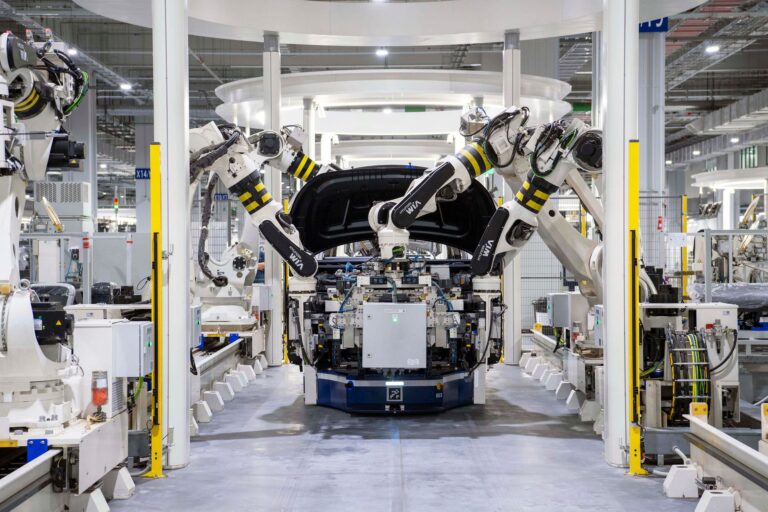
The bull case becomes concrete when you examine how modern factories actually operate. A large automotive assembly plant might run 100+ production lines, each with hundreds of robotic arms, conveyor systems, quality inspection stations, and material handling equipment. Each line is a networked system where timing, coordination, and safety are critical. A 50-millisecond delay in a control signal can cause a collision or quality defect that costs thousands of dollars. Rockwell’s Logix platform was engineered from the ground up for this deterministic, real-time environment.
The company’s controllers execute control logic with microsecond precision and handle tens of thousands of I/O points per module. This depth of engineering—the accumulated IP, the real-time operating system kernel, the safety certification, the integration testing—is why switching costs are real. A factory can’t replace this infrastructure lightly. And as factories grow more complex (adding AI-driven production optimization, predictive maintenance, supply chain integration), they increasingly depend on the platform vendor to evolve the system in compatible ways. Rockwell’s scale allows it to invest in that evolution; smaller competitors struggle to keep pace. In 2026, as factories deploy AI workflows and IoT sensors across their operations, that competitive gap is widening, not narrowing.
- —