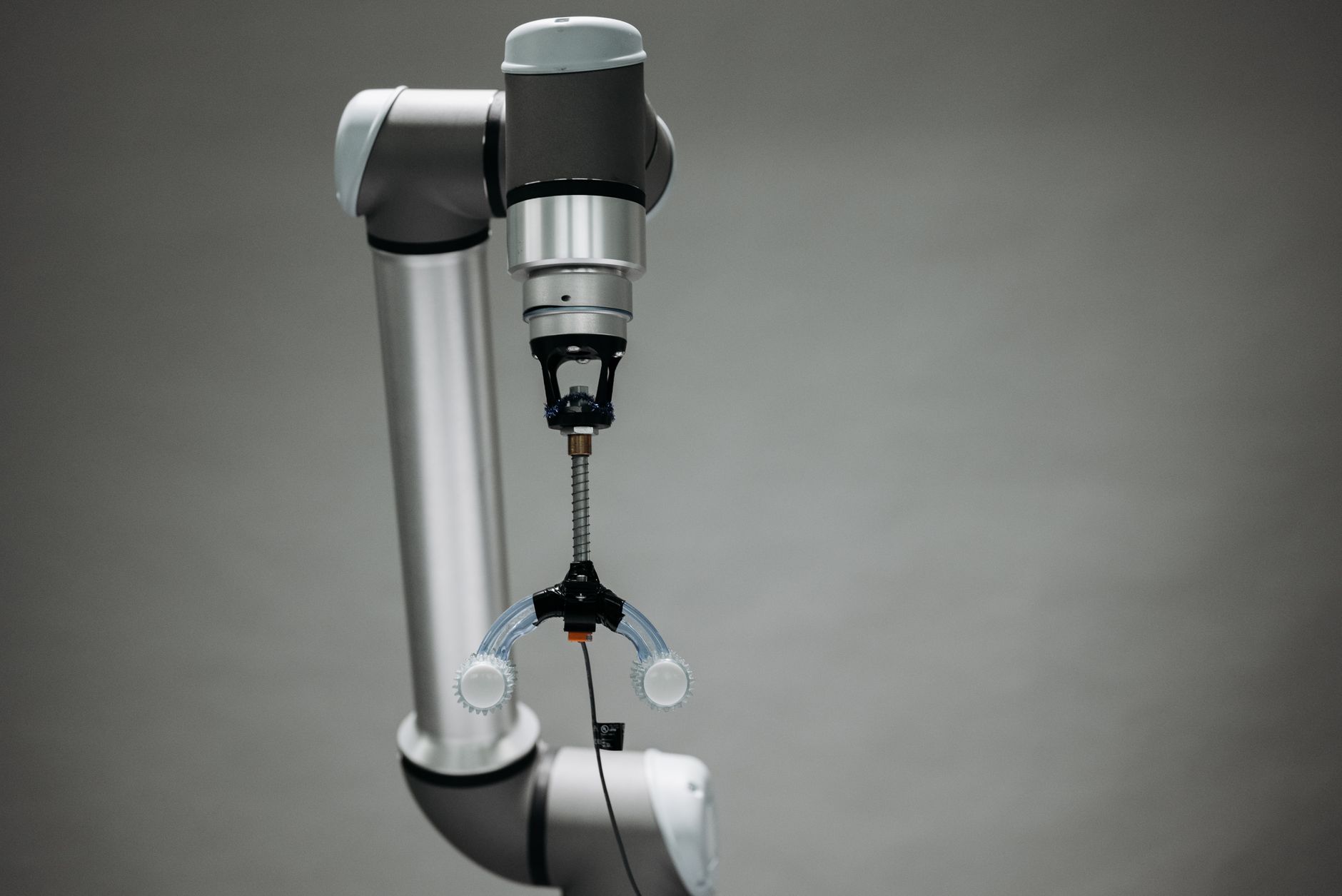

Teradyne has built a commanding position in industrial robotics without the hype machine that surrounds flashier competitors. While Tesla’s humanoid Optimus and Boston Dynamics’ Atlas dominate headlines, Teradyne operates in the unglamorous but far more profitable space where robots are actually deployed at scale—production lines, assembly floors, and fulfillment centers. The company’s acquisition of Universal Robots in 2015 gave it a foothold in collaborative robotics (cobots) that has only deepened as manufacturing automation accelerates. Today, Teradyne’s robots are working silently in thousands of facilities worldwide, moving materials, assembling components, and handling tasks too repetitive or dangerous for human workers.
The reason Teradyne remains under the public radar is structural. It sells to manufacturers and systems integrators, not consumers. Its value proposition is efficiency and cost-per-unit output, not innovation theater. A cobot installed on an auto plant floor doesn’t generate social media buzz, but it generates reliable ROI—which is precisely why manufacturers keep buying. Teradyne has positioned itself as the pragmatist in a robotics market glutted with promises, which turns out to be exactly where the real money is.
Table of Contents
- How Did Teradyne Become a Robotics Powerhouse?
- The Cobot Market and Why It Matters More Than It Appears
- Universal Robots’ Competitive Moat and Product Strategy
- Market Adoption Patterns and Geographic Differences
- The Integration Risk and Supply Chain Realities
- Software and AI: Where Teradyne Is Building Defensibility
- Financial Reality and Investor Expectations
How Did Teradyne Become a Robotics Powerhouse?
Teradyne’s entry into robotics was not organic. For decades, the company built its fortune on automated test equipment for semiconductors and electronics—the unglamorous machinery that ensures chips and circuit boards work before they ship. When the robotics wave began, Teradyne recognized that collaborative robots represented a complementary market: the same customers buying test automation might need production automation. The 2015 acquisition of Universal Robots, then a small Danish startup, gave Teradyne ownership of the fastest-growing cobot platform in the world. Universal Robots’ UR robots were already gaining traction because they solved a real manufacturing problem. Traditional industrial robots required safety cages, extensive programming, and deep technical expertise. UR’s cobots could work alongside humans, were easier to reprogram, and could be deployed in small and mid-sized facilities where traditional six-axis arms weren’t economical.
After the acquisition, Teradyne invested heavily in expanding UR’s product line and sales infrastructure. By 2023, Teradyne had sold more than 75,000 cobots globally, a figure that dwarfs most other cobot manufacturers. The acquisition also opened doors to new applications—palletizing, material handling, machine tending, and inspection—where cobots proved more flexible and cost-effective than specialized automation. What distinguishes Teradyne’s approach is patience with lower-margin business. Unlike venture-backed robotics startups chasing venture capital returns, Teradyne is a publicly traded company with steady cash flow from test equipment. This allows it to invest in market education and infrastructure without the pressure to show explosive revenue growth. It has built regional support centers, trained thousands of systems integrators to deploy cobots, and created an ecosystem of third-party software and peripherals. Competitors like abb and KUKA have larger installed bases of traditional robots, but Teradyne controls the fastest-growing segment—collaborative automation—and has the balance sheet to sustain that position through inevitable downturns.
The Cobot Market and Why It Matters More Than It Appears
Cobots represent less than 10% of the global industrial robot market by unit volume, but that proportion is rising. Traditional industrial robots dominate heavy automotive assembly where speed, payload, and repeatability are paramount. Cobots dominate everything else—light assembly, packaging, quality inspection, machine loading, and an expanding number of logistics tasks. As manufacturers face labor shortages and wage inflation, cobots become increasingly attractive because they address a specific pain point: workers don’t want repetitive, physically demanding jobs, and companies can’t find them at any price. The financial appeal is difficult to overstate. A UR5e cobot, Teradyne’s mid-range model, costs around $35,000 to $45,000 depending on configuration. An industrial robot arm from a traditional supplier can cost double or triple that. More importantly, a UR cobot can be reprogrammed and moved between tasks within days; a traditional robot, once installed, is semi-permanent.
In a manufacturing environment where product lifecycles are shortening and production volumes fluctuate, that flexibility is worth more than raw speed. Teradyne has recognized this and optimized its supply chain and design for quick deployment and redeployment. However, cobots have real limitations that matter. They are slower than industrial arms—a UR arm moves at roughly half the speed of an equivalent ABB or KUKA robot. For high-throughput automotive work, this is a deal-breaker. Cobots are also lower-payload; the UR10e, the largest, has a 10-kilogram payload, while traditional robots can handle 100 kilograms or more. This confines Teradyne’s cobots to lighter assembly and material handling. Competitors sometimes exploit this positioning, arguing that true automation requires traditional robots for serious production work. What they miss is that lighter assembly and material handling represent the majority of manufacturing tasks globally, especially in small to medium-sized factories where Teradyne’s addressable market is enormous.
Universal Robots’ Competitive Moat and Product Strategy
Universal Robots achieved something rare in industrial robotics: it created an ecosystem that others struggle to replicate. The UR platform is supported by over 3,000 certified third-party integrators and software providers. A customer can buy a UR robot from Teradyne, then purchase grippers, vision systems, force-torque sensors, and task-specific software from a marketplace of providers. This is analogous to how Windows became dominant in computing—not because it was the best operating system, but because the ecosystem of software and peripherals made it the lowest-risk choice. Teradyne has invested heavily in this ecosystem approach. It acquires selected robotics software companies, invests in startup incubators, and offers developer programs that make it easy for integrators to build on UR platforms.
In 2023, Teradyne acquired MiR (Mobile Industrial Robots), a Danish company specializing in autonomous mobile manipulators—robots that navigate factory floors with minimal human direction. This acquisition extended Teradyne’s reach into a segment that was previously independent, letting MiR robots integrate with UR arms to create fully autonomous mobile manipulation systems. The risk to Teradyne’s dominance comes from two directions: established competitors catching up in cobot design and new entrants flooding the market with cheaper models. Chinese manufacturers like Dobot and Techman are producing cobots at much lower price points, which appeals to price-sensitive customers in emerging markets. ABB and KUKA have launched competing cobot lines with improvements in speed and payload. Teradyne’s response has been to emphasize software, ecosystem breadth, and support rather than racing to the bottom on price. This is a reasonable strategy—industrial customers will pay a premium for reliability and support—but it leaves Teradyne vulnerable to disruption if a competitor achieves equivalent capability at half the cost.
Market Adoption Patterns and Geographic Differences
Teradyne’s cobot growth is uneven across markets, a reality that few analysts discuss. In North America and Northern Europe, cobots have achieved mainstream adoption. Major manufacturers routinely deploy them in assembly lines, and small job shops use them for contract manufacturing. In these markets, Teradyne holds 40-50% share of cobot installations. In Asia, adoption is higher in volume but concentrated in China and Japan; Teradyne’s presence is stronger in Japan than in mainland China, where local competitors have cost advantages. The timing of adoption matters more than market size. Manufacturers in regions with high labor costs (Northern Europe, Scandinavia, parts of North America) deployed cobots earlier because the ROI was obvious.
A company paying $25 per hour for assembly labor breaks even on a UR5e within 18 months; one paying $8 per hour takes longer. This creates a geographic concentration of Teradyne’s customer base in high-wage countries. As a result, Teradyne’s growth is sensitive to developed-market manufacturing trends. A recession in North America or Europe immediately impacts orders, whereas a competitor with stronger presence in Asia might show more resilience. Teradyne has recognized this imbalance and is pushing harder into India, Vietnam, and Southeast Asia, where manufacturing is growing and labor costs are rising. However, Chinese competitors have head starts in these regions, better pricing leverage, and existing relationships with local integrators. Teradyne’s strategy is to emphasize total cost of ownership and long-term support rather than compete on price alone. This may prove effective, but it is a slower path to market share than price competition would provide.
The Integration Risk and Supply Chain Realities
Teradyne’s acquisition strategy—buying Universal Robots, then MiR—has worked so far, but it creates integration risks that are often underestimated. Robotics companies have strong engineering cultures that are sometimes at odds with the operational discipline of a large public company. Universal Robots, in its early years, was a startup with rapid iteration cycles and flat decision-making. Teradyne, by contrast, operates as a traditional corporation with established processes for hardware design, compliance, and support. When Teradyne acquired MiR in 2020, there were immediate questions about whether MiR’s software stack could be integrated with UR’s ecosystem or whether they would remain separate product lines. Teradyne chose to keep them somewhat separate—MiR robots are typically deployed with UR arms, but MiR’s software stack remains proprietary. This limits some of the synergies that investors anticipated.
A customer cannot easily swap a MiR platform for a different autonomous mobile base; they are locked in. This is good for Teradyne’s margins but creates customer friction and makes switching to a competitor more attractive. The supply chain is another vulnerability. Teradyne, like all robotics manufacturers, relies on chip manufacturers for CPUs and microcontrollers that have been scarce since 2020. The company has managed this better than some competitors, but cobots still face component allocation challenges. During the 2021-2023 chip shortage, Teradyne could not ship cobots as fast as customers wanted to buy them, losing some market share to competitors who had better component hedging. If supply chain disruption recurs—whether from geopolitical tension, natural disaster, or recession-driven demand collapse—Teradyne’s ability to maintain production could be tested.
Software and AI: Where Teradyne Is Building Defensibility
The most defensible part of Teradyne’s robotics business is increasingly software. Robots themselves are becoming commoditized—the mechanical arms are reliable, cost-competitive, and difficult to differentiate. Where Teradyne is investing is in software that makes robots easier to program, safer to deploy, and more autonomous. Universal Robots’ UR+ software platform includes task-specific applications: machine learning-powered vision for quality inspection, force control algorithms for assembly, cloud-connected fleet management. Teradyne is also investing in AI for trajectory planning and object recognition. A cobot equipped with a machine vision system can, with proper training, learn to locate parts on a cluttered assembly line and pick them without frame-by-frame manual programming.
This capability, once the domain of high-end research robots, is trickling down into commercial cobots. Teradyne has made strategic investments in computer vision startups and has integrated their technology into UR robots. This creates competitive moats because customers who build task-specific AI models become invested in the platform. However, this is not a permanent defensibility. If open-source computer vision tools (OpenCV, PyTorch) continue to improve, and if cobots become more compatible with third-party software stacks, then the software lock-in weakens. Teradyne’s advantage is today’s integration; whether it persists depends on whether the company can evolve faster than open standards and competitor integrations erode it.
Financial Reality and Investor Expectations
Teradyne’s robotics division is profitable and growing, but it operates at lower margins than the test equipment business that historically funded the company. Test equipment margins are often 40-50%; robotics margins are closer to 20-30%. For investors and analysts accustomed to Teradyne’s historical profitability, the robotics transition has been psychologically difficult. The company’s stock price reflects this ambivalence—Teradyne trades on test equipment fundamentals, not on the excitement of robotics growth.
This creates a paradox: Teradyne has invested billions in robotics and built the largest cobot installed base in the world, yet the market often assigns zero value to it in Teradyne’s valuation. Analysts model Teradyne as a test equipment company with a robotics growth option, not as a robotics company with legacy test equipment. This mispricing may persist for years. If robotics eventually becomes 50% of Teradyne’s revenue—a realistic scenario in 5-10 years—the market may suddenly re-rate the stock significantly higher. Until then, Teradyne continues executing quietly, accumulating market share, and building defensible software platforms without the attention or valuation multiple that its robotics position arguably deserves.