
South Korea’s retail sector faces one of the developed world’s most severe labor shortages, driven by an aging population, low birth rates, and workers’ preference for office-based employment over low-wage retail jobs. Retailers across the country have turned to automation as not merely a cost-cutting measure, but as a practical necessity to keep stores staffed and operational. Convenience stores, supermarkets, and department stores have installed robot cashiers, autonomous restocking systems, and delivery robots that shoulder responsibilities that would otherwise require hiring from an increasingly thin labor pool.
The country’s demographic crisis makes this transition particularly urgent. Where other nations might phase in automation gradually, South Korean retailers are accelerating deployment to maintain service levels. A convenience store chain might install a robot to handle late-night stocking because finding night-shift workers has become nearly impossible, not because the technology offers a marginal efficiency gain. This shift represents one of the most visible adaptations of a modern economy confronting population collapse.
Table of Contents
- Why Is South Korea’s Retail Labor Crisis So Severe?
- What Types of Robots Are Deployed in South Korean Retail?
- The Economic Trade-Off: Capital Investment Versus Labor Costs
- Customer Acceptance and Service Quality Challenges
- Technical Limitations and Maintenance Challenges
- Government Support and Policy Responses
- Current Adoption Rates and Real-World Implementation
- Frequently Asked Questions
Why Is South Korea’s Retail Labor Crisis So Severe?
South Korea’s working-age population has been declining for years, compounded by the world’s lowest birth rate among developed nations. This creates a bottleneck particularly acute in retail, a sector historically filled by young workers, students, and older adults seeking supplementary income. As younger generations pursue university degrees or office employment, the retail workforce has shrunk noticeably. Wages in retail remain low relative to other sectors, making recruitment difficult even when workers are theoretically available. Convenience stores, which dot South Korea’s cities with remarkable density, face acute staffing pressures.
A typical GS25 or CU store operates 24 hours and requires multiple shifts, but securing reliable night-shift workers has become exceptionally difficult. Some stores have run with skeleton crews or asked existing staff to work dangerous extended hours. Automation emerged not as a luxury innovation but as a practical response to keep essential retail infrastructure functioning. The cultural context matters too. South Korean society has traditionally valued education and office work, leaving retail and service roles with lower social status and limited appeal to younger workers, even as the population shrinks. This combination of demographic decline and occupational preference has created a labor vacuum that technology can partially address.
What Types of Robots Are Deployed in South Korean Retail?
Convenience stores have adopted robot cashiers that handle payment processing at self-checkout stations, reducing the need for human staff during slow periods or night shifts. These systems scan items, process payments, and can be monitored remotely by a single employee managing multiple storefronts. They don’t solve the entire staffing problem—a human still must be present for age-restricted items or customer service—but they reduce labor requirements substantially. Autonomous restocking robots move through store aisles using computer vision and mapping technology, identifying empty shelves and monitoring inventory levels.
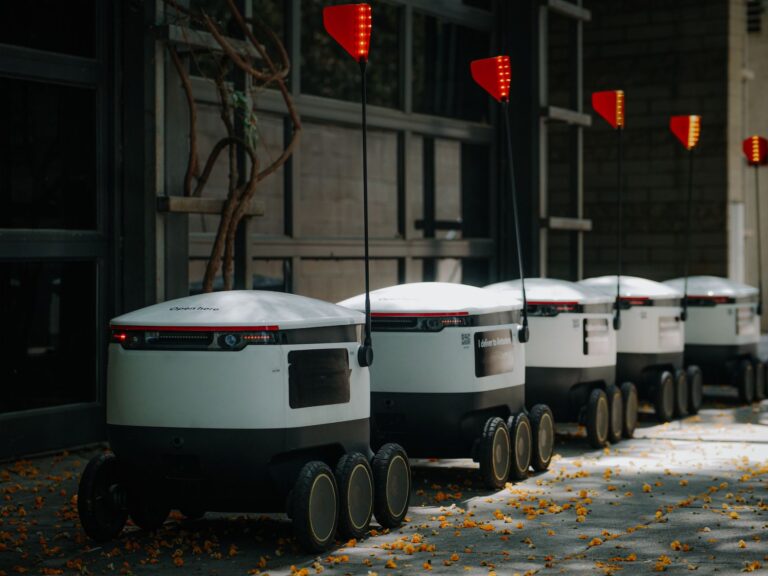
These machines can work during off-hours when the store is closed, allowing for more efficient shelf management without requiring staff presence. Unlike a cashier robot, a restocking robot doesn’t eliminate the human cashier position, but it does reduce the hours needed for stocking work, meaning fewer employees are required to maintain the same store. Delivery robots have appeared in Seoul and other cities, handling last-mile logistics for convenience stores and food delivery services. These vehicles navigate sidewalks and crossings to deliver items to customers’ homes or offices, bypassing the need for human delivery staff. The technology remains imperfect—navigating South Korea’s dense urban terrain with regular weather and traffic presents genuine challenges—but deployment continues as labor shortages make the experiment worthwhile despite limitations.
The Economic Trade-Off: Capital Investment Versus Labor Costs
Installing robotic systems requires significant upfront capital that smaller retailers cannot easily absorb. A robot cashier costs tens of thousands of dollars; a restocking robot costs more. For a small independent convenience store operator, this represents a substantial investment that may not pay back if the store operates on thin margins. Larger chains like CU and GS25 have the financial capacity to absorb these costs, giving them a competitive advantage that smaller retailers cannot match, potentially accelerating consolidation in the sector. Labor remains cheaper than robots in many contexts—a human cashier working minimum wage costs less per transaction than amortizing a robotic system over its lifespan. However, this calculation shifts when unemployment is effectively zero and workers are unavailable at any price.
In South Korea’s current environment, the comparison isn’t “robot versus cheap labor” but rather “robot versus closed store.” This changes the economic logic entirely. A retail chain must choose between investing in automation or reducing operating hours, closing underperforming locations, or accepting higher wage costs to attract scarce workers. The wage pressure is real but uneven. Some retailers have begun offering higher wages and better working conditions to compete for workers, but these improvements are not uniform across the sector. Workers with options migrate to better-paying jobs or careers, while automation gradually fills the lowest-wage, least-attractive positions. This creates a two-tier workforce where the most undesirable shifts and tasks fall to robots, and human workers handle higher-value customer interaction.
Customer Acceptance and Service Quality Challenges
South Korean consumers have shown mixed reactions to retail automation. Younger, tech-savvy customers often accept robot cashiers and automated systems without concern; some view them as convenient or novel. Older customers, however, may prefer human interaction or struggle with unfamiliar technology. A robot cannot resolve complex issues—a customer with a faulty product or a question about stock needs a human employee, and if that employee is thin on the ground due to understaffing, the customer experience suffers regardless of automation levels. A critical limitation is that robots handle routine, predictable tasks well, but retail involves significant variability.
A busy Saturday afternoon tests any system; a customer with an unusual request, a payment issue, or a need for personalized recommendation cannot be satisfactorily served by a machine. When human staff is already scarce, adding automation that handles the routine work sometimes leaves human employees overwhelmed handling only complex exceptions, negating efficiency gains. This mismatch can actually degrade service quality rather than improve it. Some retailers have found success with a hybrid model: robots handle restocking and inventory during off-peak hours, while human staff focus on customer service during busy times. This approach requires careful scheduling and system integration but can increase both efficiency and customer satisfaction. However, implementing this model requires more sophisticated planning than simply installing a robot and assuming problems solve themselves.
Technical Limitations and Maintenance Challenges
Robotic systems require maintenance, software updates, and occasional repairs, which demands technical expertise not always available in retail environments. A malfunctioning robot cashier removes an already-limited resource, potentially worsening understaffing. Small retailers may lack staff trained to troubleshoot technical issues, forcing reliance on third-party service providers, adding cost and downtime. Large chains can afford dedicated technical teams, but smaller operators may find maintenance burdensome relative to the cost savings. South Korea’s climate and urban density create specific technical challenges. Delivery robots navigate Seoul’s narrow sidewalks, steep hills, rain, and winter snow—conditions that test navigation algorithms and mechanical durability.
A robot that works flawlessly in controlled conditions may fail in real-world environments, requiring continuous refinement. Companies have deployed these systems despite known limitations because the alternative—no delivery service—is worse, but maintenance costs and repair frequency can be higher than initially projected. Security and reliability are also concerns. A cashier robot handling money requires robust fraud prevention and secure payment processing. A restocking robot moving through a store must not damage merchandise or create hazards for customers. These systems are generally reliable but not infallible, and failures can create operational disruptions. Retailers accept this risk because the alternative—relying on unavailable human labor—is not viable.
Government Support and Policy Responses
The South Korean government has recognized automation as a necessary response to demographic challenges and has provided some support for retailers adopting robotics. Subsidies, tax incentives, and favorable regulatory treatment for autonomous systems encourage deployment, particularly for convenience stores serving underserved areas. However, government support is inconsistent and sometimes limited, leaving many retailers to absorb full costs independently.
Labor unions and worker advocacy groups have raised concerns about job displacement, though their leverage is limited in a sector where labor supply is already collapsing. Rather than blocking automation, policy conversations focus on retraining programs for displaced workers and ensuring automation doesn’t exacerbate income inequality. The consensus among policymakers acknowledges that automation is a response to labor shortage, not its cause, making opposition to the technology impractical.
Current Adoption Rates and Real-World Implementation
Convenience stores represent the leading edge of retail automation in South Korea, with dozens of major chains piloting or deploying robot systems. CU has installed robot cashiers in numerous stores; GS25 has experimented with autonomous delivery systems. Major supermarkets and department stores have followed, though with slower adoption rates due to the complexity of managing inventory in larger facilities and the higher expectations for customer service in premium retail environments. The reality on the ground is uneven.
Some stores have fully operational robots that function reliably; others have systems that are still in pilot phases or underperforming. Not every convenience store has a robot, and adoption rates vary significantly by region. Seoul and major cities see more automation, while rural areas lag due to lower population density and smaller retail operations that cannot justify capital investment. This uneven deployment means that retail automation is addressing labor shortages effectively in some segments while other areas continue to struggle with understaffing and operational constraints.
Frequently Asked Questions
Are robots completely replacing human retail workers in South Korea?
No. Robots handle specific tasks like cashiering, restocking, and delivery, but human employees remain essential for customer service, problem-solving, and management. Most retail locations operate with reduced human staff supplemented by robots, not fully autonomous stores.
How much do retail robots cost to install?
Costs vary widely depending on the system. Robot cashiers range from tens of thousands to over one hundred thousand dollars; autonomous restocking systems and delivery robots cost similarly or more. For larger chains, costs can be absorbed through shared deployment across multiple locations.
Do customers prefer interacting with robots or humans?
Preferences vary by age and customer type. Younger customers often accept or prefer robot checkouts for speed and convenience. Older customers and those seeking personalized service prefer human interaction. Most retail automation works best in a hybrid model serving different customer needs.
What happens when a robot breaks down in the middle of a shift?
Repairs require technical expertise and downtime during which the robotic function becomes unavailable. Large retailers with technical staff or service contracts manage this more smoothly; smaller operations may face significant disruption. This is a practical limitation of current systems.
Is automation solving South Korea’s retail labor shortage?
Partially. Robots mitigate the impact of labor shortages by reducing the number of human workers required, but they cannot fully replace the lost workforce. Automation is a necessary adaptation, not a complete solution to demographic decline.