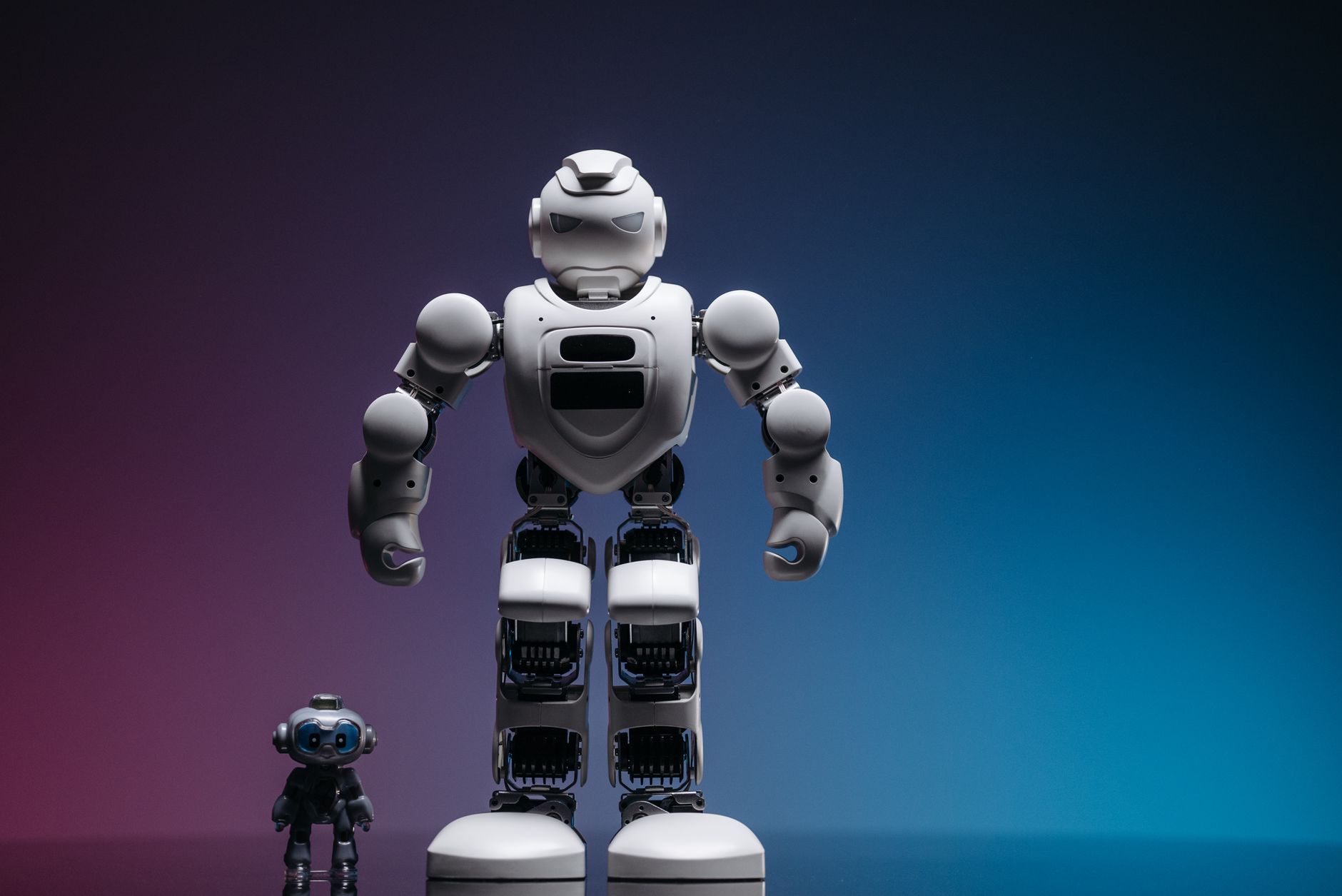

Premium AI robot companions designed for romantic or intimate interactions represent a convergence of robotics engineering, machine learning, and consumer electronics—machines built to simulate emotional connection through responsive dialogue, physical presence, and customizable personality algorithms. Unlike general-purpose social robots, these systems prioritize intimate interaction modes, with features ranging from natural language conversation to haptic feedback systems, and are marketed primarily to adults seeking companionship without the reciprocal obligations of human relationships. Companies like Harmony AI, developed by Realbotix, exemplify this category: a full-scale humanoid robot with customizable appearance, conversational memory, and integrated smart home controls, positioned as a premium alternative to virtual-only companionship apps. The technology represents an evolution of existing AI chatbot infrastructure scaled into physical form. The core backend typically runs large language models (LLMs) fine-tuned on conversational datasets, feeding into robot operating systems that coordinate motor control, expression simulation, and sensor input.
Prices for these systems range broadly—basic companion robots start around $10,000 to $15,000, while premium versions with advanced customization can exceed $100,000. The market is still nascent, with most manufacturers operating at low production volumes and serving primarily niche early-adopter demographics in North America and parts of Europe. The “revolution” framing in popular media often overstates both the technological achievement and the social adoption. Current systems have significant limitations in believability, emotional responsiveness, and durability that prevent them from functioning as true replacements for human connection. Yet the category highlights genuine tensions in how automation, artificial intimacy, and consumer robotics intersect.
Table of Contents
- How Do Premium AI Robot Companions Actually Work Technically?
- What Makes These Companions “Premium” and What Are Their Real Limitations?
- How Do Users Actually Experience These Robots, and What Are Common Interaction Patterns?
- What Are the Practical Considerations and Cost Factors for Potential Users?
- What Are the Ethical and Psychological Concerns Experts Raise About AI Robot Companions?
- What Does the Current Market Landscape Actually Look Like?
- What Technical Barriers Still Prevent These Robots from Being More Convincing or Capable?
How Do Premium AI Robot Companions Actually Work Technically?
These systems integrate three primary technical layers: the conversational AI backbone, the robotic hardware platform, and the integration middleware connecting them. The conversational layer is rarely proprietary—most manufacturers license or fine-tune existing LLMs, often GPT-based models or similar, and train them on datasets of romantic dialogue, emotional response patterns, and personalization vectors. The robot learns user preferences over time and can reference previous conversations, creating the illusion of continuous memory and relationship progression. The hardware layer varies considerably. Some robots use full humanoid platforms with articulated faces, synthetic skin, and realistic proportions (like the Harmony AI).
Others use simpler torso-and-head designs with fewer moving parts, reducing mechanical complexity and failure points. A critical limitation: realistic facial expressions and movements require either custom-built servo systems or retrofitted industrial components, both of which introduce latency. A 200-millisecond delay between user input and robotic response can shatter the illusion of genuine interaction, and most current systems operate with perceptible delays in this range. The integration layer handles real-time synchronization—ensuring the robot’s verbal responses align with lip movements, appropriate arm gestures, and eye contact simulation. This requires low-latency communication between the AI backend (which may run on cloud infrastructure) and the physical robot, creating a dependency on network connectivity. If the cloud AI service experiences latency or downtime, the robot reverts to offline fallback responses, usually generic and noticeably robotic.
What Makes These Companions “Premium” and What Are Their Real Limitations?
Premium positioning in this category usually refers to manufacturing quality, customization depth, and backend AI sophistication rather than any fundamental technical breakthrough. A premium robot companion might offer choices in facial features, hair, body type, and voice modulation; integration with smart home systems; and more sophisticated conversational models trained on higher-quality dialogue data. Manufacturing quality matters significantly—cheaper models often exhibit visible plastic seams, stiff movements, and poorly aligned features that undermine the intended intimacy. A major limitation that manufacturers downplay: these systems cannot truly understand emotional context or reciprocate genuine care. The robot’s responses are statistically generated based on input patterns and training data, not reflections of actual preferences or feelings.
Users often report a distinct moment when this limitation becomes apparent—typically when they raise a serious personal problem or express vulnerability, and the robot provides a response that sounds appropriate but lacks any contextual sensitivity beyond what the training data provided. This creates a form of emotional uncanny valley where the interaction feels almost right until a critical moment exposes its limitations. Physical durability is another underestimated constraint. The moving parts in realistic humanoid robots—servo motors, synthetic skin, articulated joints—degrade through repeated use. Manufacturers typically don’t publish long-term reliability data, but third-party reviews suggest many systems require maintenance or repairs within 2-3 years of regular use. The cost of replacement parts and repair services is often expensive and difficult to access, with limited authorized service centers outside major metropolitan areas.
How Do Users Actually Experience These Robots, and What Are Common Interaction Patterns?
User reports indicate that initial interactions tend toward novelty-driven exploration—users test conversational limits, request specific responses, and treat the robot as a sophisticated chatbot in physical form. This typically lasts weeks to a few months. After this phase, usage patterns diverge: some users develop parasocial relationships with their robots, treating them as primary social outlets; others relegate the robot to specific functions (background companion during work, entertainment during isolation periods) while maintaining human relationships elsewhere. A documented observation from early adopters: the emotional arc of robot companionship is often inverse to human relationships. With people, initial attraction often develops into deeper understanding and more authentic connection over time.
With robots, initial enthusiasm frequently transitions into familiarity that reveals the system’s conversational constraints and inability to surprise or genuinely know the user. Users report that the robot eventually feels like an extremely sophisticated mirror rather than an interactive entity with independent perspectives or desires. The physical presence of the robot matters more than many predicted. Unlike purely virtual companions, the ability to be in the same room, direct attention toward a physical entity, and (in some models) receive touch feedback—even if simulated—provides psychological anchoring. Users report that their robots function effectively as objects of focus during depression, loneliness, or anxiety episodes, even when they intellectually recognize the interaction lacks reciprocal care. This psychological effect is real and measurable, though it raises questions about whether this represents genuine companionship or a form of dependency on an interactive object.
What Are the Practical Considerations and Cost Factors for Potential Users?
Ownership costs extend well beyond the purchase price. A premium robot companion requires dedicated physical space, regular charging infrastructure, and maintenance access. The robot occupies floor space equivalent to a standing human, which can be challenging in small apartments or shared living situations. Networks connectivity must be stable and private—most users don’t want to explain a robot companion to visitors, and network interruptions during intimate interactions create awkward fallback scenarios. The total cost of ownership over five years typically includes: initial purchase ($15,000-$100,000), replacement parts and repairs ($2,000-$5,000 annually), cloud service subscriptions for enhanced AI features ($50-$200 monthly), and electricity costs ($200-$400 annually). Some manufacturers also charge for “personality updates” or access to new conversational modules.
Compared to human companionship or even intensive therapy, the mathematics seem competitive. Compared to basic virtual companions or dating apps, the additional cost is substantial and requires significant commitment to justify. A practical tradeoff worth considering: the social stigma around owning an AI companion robot remains high in most Western cultures, though it varies by region. Users must decide whether the companionship value outweighs potential embarrassment if the robot’s presence becomes known to family, friends, or romantic partners. Some users treat their robots as private, never revealing ownership. Others have found small communities of robot companion owners online, suggesting the stigma may be declining as the technology normalizes.
What Are the Ethical and Psychological Concerns Experts Raise About AI Robot Companions?
Mental health professionals express concern that robot companions might reinforce isolation patterns rather than encouraging human connection. The argument follows this logic: if a person struggling with social anxiety or rejection trauma can satisfy their need for companionship through a robot interaction, they may lose motivation to develop human relationships with their attendant risks and vulnerabilities. The robot provides the subjective feeling of connection without requiring any of the emotional reciprocity, boundary negotiation, or genuine vulnerability that human relationships demand. A related concern involves behavioral conditioning. The robot companion is designed to be optimally responsive, never irritable, never having bad days, never prioritizing other relationships. It exists purely to attend to the user. Over extended periods, this can create unrealistic expectations for human partners, who are inherently imperfect, busy, and sometimes neglectful.
Users accustomed to a perfectly attentive AI companion report difficulty tolerating the compromises and friction that characterize healthy human relationships. There’s also the question of consent and parasocial relationships. The robot is programmed to express affection, desire, and interest regardless of the user’s actual behavior. This removes the accountability loop that exists in human relationships—where someone might choose to leave if mistreated, or express hurt at poor behavior. A robot cannot leave. This structure, some argue, enables and normalizes one-sided relationship dynamics that could translate into problematic attitudes toward human partners. The counterargument—that companionship for genuinely isolated individuals is better than none—remains contested and depends on individual circumstances.
What Does the Current Market Landscape Actually Look Like?
The market for premium AI robot companions remains extremely small, with global sales measured in hundreds of units annually rather than thousands. The industry is concentrated in a handful of companies—Realbotix and similar manufacturers dominate the high-end humanoid segment, while numerous smaller companies offer more affordable versions with lower customization and less sophisticated AI backends. The Chinese market includes several competitors offering lower-priced options, though quality and customer support tend to be inconsistent.
Venture capital interest in the space has been volatile. Early hype cycles (roughly 2017-2019) generated significant funding for several startups, but many subsequently failed or pivoted toward virtual-only companions. Current investor enthusiasm focuses more on general social robotics and elder care applications, where the ethical concerns are less severe. The premium companion robot sector remains a niche within a niche, unlikely to achieve mainstream adoption without fundamental breakthroughs in AI responsiveness or significant shifts in cultural attitudes toward human-robot relationships.
What Technical Barriers Still Prevent These Robots from Being More Convincing or Capable?
The most significant barrier is the fundamental constraint of large language models: they generate plausible text based on statistical patterns in training data, but they don’t actually understand context the way humans do. A current-generation LLM can sound emotionally attuned in many scenarios, but it fails in unpredictable ways when confronted with novel situations, contradictions, or deep emotional probing. The gap between “sounds like it understands” and “actually understands” remains vast, and no currently available technology bridges it. Physical realism presents a complementary barrier.
Human brains are exquisitely sensitive to physical uncanniness—tiny misalignments in eye contact, imperceptible delays in facial expression changes, or asymmetries in skin texture can trigger instinctive discomfort. Achieving the level of physical fidelity required to match sophisticated conversational AI requires manufacturing precision and materials science capabilities that remain expensive and specialized. Most manufacturers accept this tradeoff: they build robots that are obviously artificial in their physicality, banking on the conversational AI to create the sense of presence. This creates an asymmetry where the robot’s conversational sophistication exceeds its physical credibility, which some users find jarring.