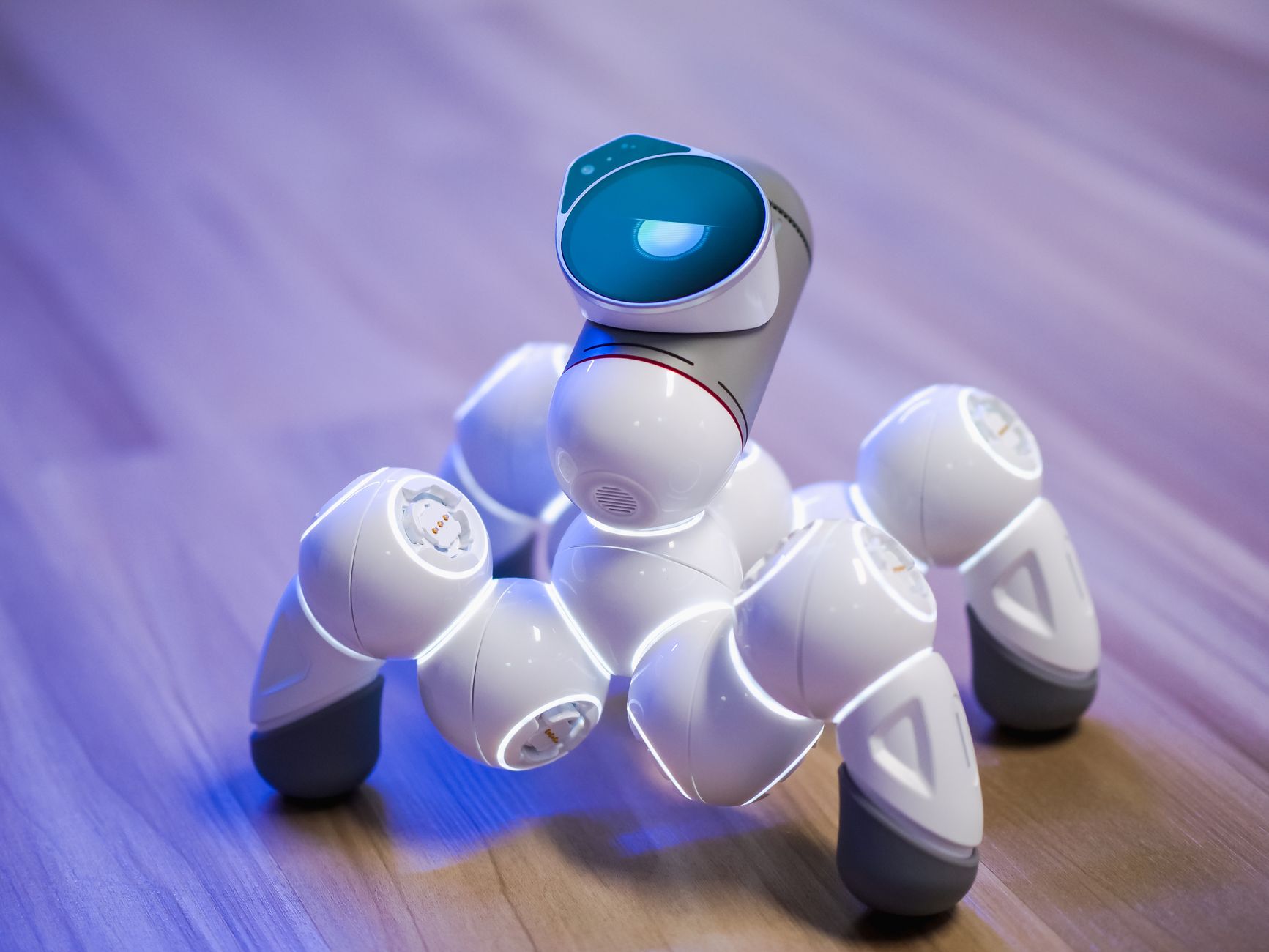

Quadruped robots have achieved significant improvements in navigating complex terrain through advances in AI training methods, though the field remains in an active development phase rather than a fully solved problem. Recent work in reinforcement learning and simulation-to-reality transfer has enabled four-legged robots to traverse rocky slopes, uneven ground, and obstacles that would have required manual programming for each new environment just five years ago.
The breakthrough lies not in one specific moment but in the convergence of better neural network architectures, improved training data collection strategies, and more sophisticated physics simulators that can teach robots behaviors before they ever attempt real-world navigation. The practical impact is already visible: research robots and early commercial systems can now adapt to terrain variations in real-time without requiring engineers to reprogram the robot’s gait for each new surface. A robot trained on diverse terrain in simulation can transfer that knowledge to physical robots and adjust its behavior based on local conditions—sand, gravel, grass, or concrete—using onboard sensors and learned models rather than hardcoded rules.
Table of Contents
- How Does AI Training Enable Quadruped Terrain Adaptation?
- The Reality Gap and Training Limitations
- Real-World Quadruped Examples and Current Capabilities
- Training Data Collection and Sim-to-Real Transfer Strategies
- Sensor Reliability and Recovery from Unexpected Obstacles
- Computational Requirements and Edge Deployment
- Future Directions and Multimodal Learning Approaches
- Frequently Asked Questions
How Does AI Training Enable Quadruped Terrain Adaptation?
AI-based quadruped training typically combines simulation-based learning with reinforcement learning algorithms that optimize for multiple objectives simultaneously: speed, stability, energy efficiency, and the ability to recover from stumbles. Rather than programming specific gaits for each terrain type, the robot learns a policy that maps sensor inputs (leg angles, ground contact forces, IMU data) to motor commands. This learned policy can generalize to new surfaces because it captures the underlying principles of dynamic balance rather than memorizing specific joint trajectories.
The training process usually begins in a physics simulator where the robot can safely fail millions of times without damage. Simulators like PyBullet or Gazebo allow engineers to model different terrain types, friction coefficients, and obstacle configurations. A robot trained on diverse simulated terrain—including surfaces it has never physically encountered—can often transfer that knowledge to the real world with minimal additional fine-tuning. For example, a quadruped trained on simulated rocky terrain with variable friction can handle actual uneven outdoor ground with surprisingly little degradation in performance, though real-world variability always introduces some challenges.
The Reality Gap and Training Limitations
The most significant challenge in quadruped AI training is the reality gap—the mismatch between behavior learned in simulation and actual physical performance. A robot’s joints have friction and backlash not perfectly captured in simulation; actuators have latency; ground surfaces have properties simulators approximate but never perfectly model. A gait that works flawlessly in a simulator might fail on real terrain because the robot’s actual motors respond slightly differently, or because real grass has different dynamics than the simulated version. researchers address this through domain randomization, deliberately introducing noise and variations during training so the learned policy becomes robust to real-world imperfections.
By training on a range of friction coefficients, motor delays, and terrain variations in simulation, the robot learns to be adaptable rather than brittle. However, this approach has limits: you cannot randomize parameters you do not know exist. Unexpected terrain properties or sensor failures that were never included in training can still cause the robot to stumble. Additionally, training time remains substantial—days to weeks of simulation time on powerful hardware for a new terrain type or new robot morphology.
Real-World Quadruped Examples and Current Capabilities
Boston Dynamics’ Spot and the MIT Cheetah robots represent two different approaches to terrain adaptation. Spot relies heavily on classical control and perception, using cameras and lidar to detect obstacles and choose appropriate footholds, combined with AI-assisted gait planning. The MIT Cheetah uses learned neural network policies for locomotion, allowing it to bound across rough terrain at high speeds with minimal explicit obstacle avoidance. Both systems achieve terrain adaptation, but they optimize for different priorities: Spot for reliability and precise control, Cheetah for speed and dynamic movement.
A practical limitation appears when these robots encounter terrain categories outside their training distribution. A quadruped trained on outdoor rocky terrain may struggle on slippery surfaces or in deep sand because these require fundamentally different force dynamics. Each new terrain class typically requires retraining or significant fine-tuning, adding weeks to deployment timelines. Real-world deployments therefore tend to be conservative: robots are trained on terrain representative of their target environment, with safety margins built in, and operators maintain the ability to take manual control if the terrain becomes too unpredictable.
Training Data Collection and Sim-to-Real Transfer Strategies
Effective terrain navigation requires training data that covers relevant variation. Some projects use carefully recorded sensor data from robots walking on real terrain, which is time-consuming but captures true variability. Others use teleoperation, where a human operator controls the robot and records successful motions that then seed the training data. Kinesthetic teaching—physically guiding the robot through movements—can help establish initial behaviors that learning algorithms then optimize.
The transfer from simulation to reality works better when the training includes explicit uncertainty modeling. Rather than assuming the simulator perfectly captures the real world, trainers use methods like probabilistic models that output confidence intervals alongside action predictions, or ensemble methods that use multiple neural networks whose disagreement signals uncertainty. A robot that knows when it is unsure can switch to more conservative behaviors. However, this approach requires more complex training and higher computational overhead during deployment, creating a tradeoff between adaptability and the simplicity of running inference on the robot’s onboard compute hardware.
Sensor Reliability and Recovery from Unexpected Obstacles
One underestimated challenge in quadruped terrain navigation is sensor degradation. An IMU (inertial measurement unit) can drift, a camera lens can get dirty, or an actuator can develop hysteresis over time. AI policies trained on pristine sensor data may fail gracefully when sensor quality degrades slightly, but they can also mask these failures until they accumulate into dangerous situations. A robot’s onboard inference systems need monitoring to detect when sensor data looks anomalous, and retraining to be robust to minor sensor drift.
Recovery from unexpected obstacles requires both perception and rapid policy execution. A neural network policy running at high frequency (50–100 Hz) can adjust foot placement quickly, but only if the robot’s sensors detect the obstacle in time. Low-visibility environments—thick fog, darkness, or sensor-confusing materials like mirrors—remain difficult. Some robots compensate by trading speed for caution, moving slowly enough to recover from errors, but this limits their practical utility. Terrain with hidden hazards like holes or very steep drop-offs represents a genuine limitation: no amount of learned behavior can safely navigate a cliff if the robot’s sensors cannot detect it before the step.
Computational Requirements and Edge Deployment
Training neural network policies for quadruped locomotion demands significant compute, often requiring GPU clusters to simulate thousands of robot hours per day. However, running the trained policy on a physical robot only requires inference on the onboard computer. A single neural network with a few million parameters can run at high frequency on modest hardware like an Nvidia Jetson or even smaller embedded systems, making real-time terrain adaptation feasible without external computation.
Power consumption during real-world operation remains a constraint. A quadruped with onboard batteries operating for hours in field conditions needs efficient policies. Overly large neural networks can drain batteries quickly, so researchers often compress trained policies through knowledge distillation or pruning, trading minor accuracy for substantial efficiency gains. A smaller, faster-running policy might make slightly different gait choices than the original, but if the degradation is small enough, the power savings justify the loss.
Future Directions and Multimodal Learning Approaches
Emerging work combines terrain navigation with manipulation and perception in more integrated ways. A quadruped with an onboard manipulator arm might learn to lean on obstacles for stability or adjust its gait based on what its gripper is carrying. Vision-based navigation, where the robot learns to predict terrain properties from camera images before stepping, can improve speed by preemptively choosing better foot placements.
These multimodal approaches require more complex training pipelines but can dramatically improve robustness. Long-term deployment and learning remains an open problem: robots in the field experience terrain variations continuously, and static trained policies become outdated. Active learning systems that detect low-confidence predictions and request human feedback, or online learning methods that slowly adapt policies based on real-world experience, could make robots improve over months and years of deployment. These approaches introduce new risks—a robot that learns from mistakes could also learn unsafe behaviors if feedback is misaligned with actual safety goals—so implementation requires careful oversight.
Frequently Asked Questions
Can a quadruped trained in simulation work without real-world retraining?
Often yes, within limits. Domain randomization during training helps transfer to reality, but some fine-tuning usually improves performance. Results vary depending on how closely the simulated terrain matches real deployment conditions.
How long does it take to train a quadruped for new terrain?
Simulation training typically requires days to weeks depending on terrain complexity and available computing power. Real-world fine-tuning can add days to weeks more, but modern transfer learning can significantly reduce this time.
What happens when a quadruped encounters terrain it was never trained on?
Performance degrades gracefully in many cases, but unexpected terrain types—especially very slippery or very soft surfaces—can cause failures. This is why careful training on diverse terrain remains important.
Do quadrupeds need onboard GPUs for terrain navigation?
Not necessarily. Inference of trained neural network policies can run on modest embedded CPUs at real-time frequencies. Full training requires GPU compute, but deployment does not.
How do researchers handle sensor failures during navigation?
Most systems use sensor validation and fallback behaviors. Some implement ensemble methods where disagreement between multiple sensor streams triggers more conservative movement. Monitoring and scheduled maintenance remain important for field robots.
Can one trained policy work across many different quadruped designs?
Generally no—policies are specific to the robot’s morphology, actuators, and sensors. Transferring across different designs requires retraining, though meta-learning approaches show promise in reducing this burden.