
Symbotic is not the next Nvidia—it’s potentially something more valuable to the logistics industry right now. While Nvidia dominates AI chip design, Symbotic controls end-to-end warehouse automation systems that are generating immediate, measurable returns for major retailers. In fiscal year 2025, Symbotic posted $2.247 billion in revenue with 26% year-over-year growth and swung to profitability in Q1 FY2026 after years of losses. The company’s stock surged 134% during 2025, outperforming both Nvidia and Palantir, and Walmart’s $520 million investment alongside the $200 million acquisition of Walmart’s own robotics division created a backlog exceeding $5 billion. This isn’t hype—it’s the tangible evidence of a company solving an acute operational problem at scale.
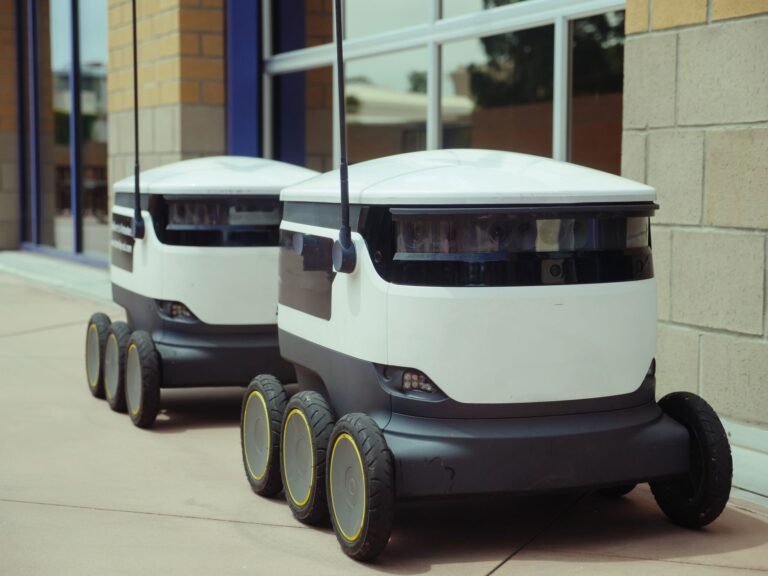
The warehouse automation space differs fundamentally from the semiconductor arms race. Symbotic’s robots don’t just promise future disruption; they’re already deployed across distribution networks for Target, Albertsons, Kroger, and Walmart, where they pick individual cases five times faster than human workers and reduce product damage by 30% during transit. The company’s 80–85% gross margins on automation systems, combined with consecutive profitable quarters, suggest the market has validated the value proposition. The real question isn’t whether Symbotic will become an industry force—it already has. The question is whether current valuations reflect the scale of opportunity in a logistics sector desperate for labor solutions.
Table of Contents
- Can Warehouse Robotics Scale as Fast as Semiconductors?
- The Profitability Inflection Point and Its Fragility
- Why the Comparison to Nvidia Actually Misses the Point
- How Gross Margins of 80–85% Translate to Real Defensibility
- The Hidden Risk of Deployment Bottlenecks
- Market Position Among Competitors
- Future Outlook and International Expansion
- Conclusion
- Frequently Asked Questions
Can Warehouse Robotics Scale as Fast as Semiconductors?
Symbotic’s Q1 and Q2 FY2026 results suggest yes, though with caveats. Q1 FY2026 revenue hit $630 million with 29% year-over-year growth and a dramatic profitability swing: the company posted $13 million in net income versus a $17 million loss in the prior-year quarter. Q2 FY2026 extended the trend with $676 million in revenue and $78 million in adjusted EBITDA—more than double the $35 million achieved in Q2 FY2025. For comparison, Nvidia’s consistency comes from chip cycles tied to global demand; Symbotic’s growth tracks the adoption curve of a relatively new category.
The company is still early in market penetration despite commanding 80% of the warehouse robotics market by some estimates. The limiting factor isn’t technology but installation capacity and capital. Symbotic must actually build and deploy systems in customer facilities, which requires engineering teams, on-site work, and integration complexity that semiconductor manufacturing doesn’t face to the same degree. Walmart’s $5 billion+ backlog is a blessing and a constraint—it represents future revenue but also signals Symbotic may struggle to fulfill demand faster than competitors can emerge. The company’s gross margins remain exceptional precisely because systems are complex and hard to replicate, but that defensibility isn’t a guarantee if new entrants raise capital and hire talent aggressively.
The Profitability Inflection Point and Its Fragility
Symbotic’s shift from a net loss of $91 million in FY2025 to consecutive profitable quarters represents a genuine inflection, but investors should understand the mechanics beneath the headlines. The company was bleeding cash for years while building the Fox Robotics acquisition and scaling manufacturing. Q1 FY2026’s $67 million in adjusted EBITDA and Q2’s $78 million demonstrate that at volume, the unit economics work. Yet profitability arrived alongside massive leverage—the Walmart deal and subsequent investment created a backlog that now defines growth expectations. If large customers slowed deployment or the economy contracted, Symbotic would face fixed costs tied to that backlog and could revert to losses quickly.
The Walmart relationship amplifies this risk. Symbotic is no longer an independent supplier; it’s partly Walmart’s robotics partner and operator. This reduces customer diversification and creates a single-customer concentration risk that institutional investors typically penalize. If Walmart’s distribution network investment plateaus or shifts strategy toward different automation approaches, Symbotic loses its largest growth driver. Conversely, the Walmart partnership locked in $520 million of capital and a $5 billion+ backlog, which is why the stock has rallied. The profitability milestone is real, but it’s contingent on Walmart executing its own strategy and Symbotic delivering on aggressive deployment schedules.
Why the Comparison to Nvidia Actually Misses the Point
nvidia became a dominant force because AI adoption cut across dozens of industries and use cases simultaneously. The company’s chips are inputs to thousands of applications—language models, image generation, data centers, autonomous vehicles, drug discovery. Symbotic addresses a narrower, more specific problem: warehouse labor productivity and cost reduction. This focus is actually a strength for near-term cash generation and valuation multiple expansion, but it creates a ceiling that Nvidia doesn’t face. Consider the addressable market.
There are roughly 70,000 warehouses across the United States, but Symbotic’s system is economically justified primarily in large-scale distribution centers processing millions of units monthly. Target, Albertsons, and Kroger operate hundreds of distribution facilities, so Walmart and similar mega-retailers represent the bulk of TAM for the foreseeable future. Symbotic doesn’t have Nvidia’s advantage of serving a market that touches nearly every sector. Instead, it has the advantage of solving a problem so acute that companies will spend billions to address it. The comparison is apt for stock performance—both have surged on productivity gains—but the business models diverge sharply.
How Gross Margins of 80–85% Translate to Real Defensibility
High gross margins in automation systems suggest Symbotic has built genuine moats: proprietary algorithms for pallet optimization and case picking, software integration that ties into customer systems, and accumulated expertise from thousands of deployed units. When a system reduces damage by 30% during transit and picks five times faster than human workers, customers cannot easily replace that with a cheaper competitor. The economics justify the system cost, and switching costs are high. However, gross margins don’t guarantee business resilience.
Symbotic must still invest heavily in R&D to stay ahead of emerging competitors like Agility Robotics and established players like Kiva Systems (Amazon). The company must also manage the capital intensity of manufacturing and deployment. Margin compression is a constant threat if competitors raise capital, build scale, and undercut pricing to gain share. Symbotic’s 80–85% margins today reflect a market in early adoption; consolidation and competition will narrow those margins eventually. The current profitability window is real but temporal.
The Hidden Risk of Deployment Bottlenecks
Symbotic’s backlog exceeds $5 billion, which sounds like a luxury problem until you consider execution risk. Deploying warehouse robotics isn’t like shipping semiconductors; it requires teams to work on-site, customize systems, train staff, and integrate with legacy infrastructure. If Symbotic cannot hire engineering talent fast enough to deploy systems according to Walmart’s timeline, revenue will slip and the stock will retrace. The Fast Company recognition as the #9 most innovative company in Robotics & Engineering validates the technology, but recognition doesn’t deploy robots.
Walmart has an incentive to keep Symbotic accountable. The retailer is deploying these systems across its distribution network and has invested $520 million to ensure they work. Delays cascade through Walmart’s supply chain, creating cost and competitive harm. This is actually a strength for Symbotic—Walmart’s operational demands will force disciplined execution—but it also creates vulnerability if Symbotic slips on timelines. The company must maintain manufacturing capacity, hiring, and quality standards simultaneously, which is a perennial challenge for fast-scaling industrial companies.
Market Position Among Competitors
Symbotic isn’t alone in warehouse automation, though it holds the largest share by system revenue. Competitors like Dexterity (autonomous case picking), Locus Robotics (collaborative robots), and smaller players capture segments of the market. Symbotic’s advantage is vertical integration: it controls picking robots, pallet optimization algorithms, autonomous mobile robots, and the software layer that ties it together. This end-to-end approach creates stickiness and allows the company to optimize across the entire system.
Most competitors offer point solutions or focus on one layer of the stack. This vertical advantage has limits. If a competitor develops a superior picking algorithm or a more flexible mobile platform, they can potentially displace Symbotic through acquisition (as Walmart did with its own robotics division) or partnership with a large retailer. Technology in warehouse automation is advancing faster than in many sectors, so Symbotic must innovate continuously to maintain edge. The company’s recent Q3 FY2026 guidance of $700–$720 million in revenue and $80–$85 million in adjusted EBITDA shows confidence, but it also assumes successful execution and no major competitive disruption.
Future Outlook and International Expansion
Symbotic’s current market is dominated by North American retailers, and that’s where the backlog is concentrated. The next phase of growth will likely come from international expansion—European and Asian logistics companies face the same labor constraints and will eventually demand automated solutions. However, international deployment introduces new complexities: regulatory differences, local competition, currency risk, and the need to establish relationships with new customer bases. Symbotic’s model works when it can bundle technology, installation, and ongoing support; replicating that globally is ambitious.
The broader trend favoring Symbotic is structural. Labor in logistics continues to tighten, and consumer expectations for faster delivery create pressure to automate. E-commerce growth has increased the volume of items flowing through distribution networks, making automation more economically justified. Symbotic’s next five years will determine whether it becomes a true global player or remains a high-margin specialist in North American retail logistics. The stock’s 134% surge in 2025 prices in significant international expansion and continued profitability growth—ambitious but not unreasonable given the backlog.
Conclusion
Symbotic is the next major force in logistics infrastructure, though not because it’s “the next Nvidia.” The comparison works as a shorthand for stock performance and market timing, but the actual comparison is between a narrowly focused automation specialist and a data center chip architecture company. Symbotic solves a specific, acute problem—warehouse labor and efficiency—better than anyone currently available. Its $5 billion+ backlog, 80–85% gross margins, and consecutive profitable quarters prove the market will pay for that solution.
The risks are real: deployment bottlenecks, customer concentration on Walmart, and the inevitability of competition narrowing margins over time. But for investors and logistics operators asking whether warehouse automation is here to stay, the answer is decidedly yes. Symbotic’s success in 2025 and early 2026 reflects a market that has moved past skepticism and into adoption. The question now is whether the company can execute at scale and maintain technology leadership—not whether the market exists.
Frequently Asked Questions
Is Symbotic profitable?
Yes. The company swung to profitability in Q1 FY2026 with net income of $13 million and adjusted EBITDA of $67 million, after posting a $91 million net loss in FY2025. Q2 FY2026 continued the trend with $9 million in net income and $78 million in adjusted EBITDA.
What is the Walmart relationship?
Symbotic acquired Walmart’s Advanced Systems and Robotics division for $200 million in January 2026. Walmart simultaneously invested $520 million in Symbotic and has committed to deploying AI-powered robotics across its distribution network, creating a backlog exceeding $5 billion.
How fast do Symbotic robots work compared to humans?
Symbotic robots pick individual cases from pallets five times faster than human workers and reduce product damage by 30% during transit through AI-optimized pallet building.
What are Symbotic’s gross margins?
The company maintains 80–85% gross margins on automation system sales, which is exceptionally high for industrial equipment and reflects the specialized, capital-intensive nature of the systems.
Why is Symbotic compared to Nvidia?
Both companies surged significantly in 2025 on productivity and automation narratives. Symbotic’s stock gained 134% in 2025, outperforming both Nvidia and Palantir, though the business models differ substantially.
What is the guidance for Q3 FY2026?
Symbotic expects Q3 FY2026 revenue of $700–$720 million with adjusted EBITDA of $80–$85 million, indicating continued growth and profitability expansion.