
Nvidia could indeed become the next industrial standard in robotics—not as a hardware manufacturer alone, but as the foundational software and silicon platform that every robotics company builds upon. This isn’t speculation about what might happen; it’s already happening. ABB, Fanuc, and Yaskawa—three of the world’s largest robotics manufacturers—are actively integrating Nvidia’s Omniverse libraries and Isaac simulation frameworks into their platforms. Nvidia’s CEO has stated plainly that “every industrial company will become a robotics company,” signaling the company’s belief that robotics adoption is inevitable across industries and that Nvidia intends to own the underlying infrastructure.
What makes this different from Nvidia’s dominance in AI chips is the scope. In artificial intelligence, Nvidia controls the hardware that trains models. In robotics, the company is attempting something broader: to become the operating system layer, the simulation environment, and the inference hardware all at once. If successful, this would mirror Android’s role in smartphones—the platform everyone builds on rather than a competitor fighting for market share.
Table of Contents
- How Nvidia Is Becoming the Robotics Industry Standard
- The Android of Robotics—How Nvidia’s Platform Strategy Works
- The Hardware Foundation—Jetson and Blackwell’s Role
- Industrial Integration—Where the Standard Is Already Taking Hold
- The Risks of a Dominant Standard—What Could Go Wrong
- The Physical AI Market Boom
- What Industrial Standardization Means for the Future
- Conclusion
How Nvidia Is Becoming the Robotics Industry Standard
The path to industrial standardization usually requires two things: overwhelming technical capability and critical mass of adoption. nvidia has both. The physical AI market is projected to reach USD 15.24 billion by 2032, growing from USD 1.50 billion in 2026, at a compound annual growth rate of 47.2%. That’s not a niche market anymore; it’s a major industrial vertical, and Nvidia is positioned at its center. The company isn’t selling robots. It’s selling the brain, the training ground, and the simulation environment that makes modern industrial robotics possible. Consider the competitive landscape. Robotics companies face a fundamental problem: training robots to handle real-world variation is expensive and slow.
Nvidia’s Isaac simulation platform allows companies to train robots in virtual environments, dramatically reducing the cost and time required to deploy new capabilities. ABB, Fanuc, and Yaskawa have already chosen this path. When the three largest industrial robotics manufacturers all choose the same platform, that choice becomes sticky. Their customers learn the tools, their engineers build expertise, and switching becomes costly. The risk here is real for companies betting against Nvidia’s infrastructure. A robotics company that builds on competing platforms—say, open-source alternatives or proprietary systems from cloud providers—will find itself at a disadvantage as Nvidia’s ecosystem grows. They’ll have fewer pre-trained models to work with, smaller communities of developers sharing solutions, and less access to cutting-edge simulation and optimization tools. This is how standards form: not through committee decisions, but through dominance in capability and the gravity that pulls everyone into the same ecosystem.
The Android of Robotics—How Nvidia’s Platform Strategy Works
Nvidia is explicitly positioning itself as the “Android of generalist robotics,” according to reporting from TechCrunch in January 2026. The comparison is instructive. Android didn’t win by being a better phone; it won by becoming a shared platform that hardware makers, software developers, and service providers could all build upon. It became the standard because it reduced fragmentation and accelerated innovation across the ecosystem. Nvidia’s strategy in robotics follows this template. The Blackwell architecture provides the raw computational power. The Jetson platforms provide the form factors—from edge devices running on robots to data center-class systems handling heavy simulation workloads. The Isaac suite provides the software stack: simulation engines, sensor processing libraries, and machine learning frameworks specifically designed for robotics. A robotics company can focus on their competitive advantage—their mechanical design, their control algorithms, their specific application domain—while building on Nvidia’s infrastructure. This division of labor is efficient.
It’s also limiting if you want to compete on hardware and software strategy independently. The real power of this approach lies in the middleware and ecosystem effects. Nvidia’s Omniverse platform acts as a digital twin environment where physical robots are tested and trained. As more companies use Omniverse, more simulation assets and trained models become available. Those models can be reused and fine-tuned by other companies. This creates a virtuous cycle: more users drive more tool development, which attracts more users. Breaking this cycle requires either a radically superior alternative or a compelling reason to fragment the ecosystem. For most robotics companies, neither exists today. The limitation is that this power dynamic ultimately concentrates strategic control at Nvidia. If the company decides to increase licensing costs or pivot its platform roadmap, companies deeply integrated into the ecosystem have limited options for rapid migration.
The Hardware Foundation—Jetson and Blackwell’s Role
The actual silicon matters. Nvidia’s Jetson platform has become the standard inference processor for robots in the field—everything from collaborative arms to autonomous mobile robots. The newer Blackwell architecture extends this capability to more demanding workloads, enabling real-time vision processing, natural language understanding, and complex decision-making directly on the robot. This matters because it means robots can operate with lower latency and greater autonomy. They don’t need to send every sensor reading to a cloud server and wait for a response. They can think locally. Competitors offering alternative processors—whether from ARM, AMD, Intel, or specialized robotics chip makers—face a credibility gap.
Nvidia has optimized its hardware and software together for years. The Jetson runs the Isaac toolkit natively. The developer documentation is extensive. Code written for one Jetson generation often runs on the next with minimal changes. This backward compatibility and software stability is genuinely valuable for companies building long-lived robots. A warning: over-reliance on a single vendor’s hardware creates single points of failure. If supply chain disruptions affect Nvidia’s production, or if geopolitical tensions restrict chip exports, companies without alternative processors face serious operational risk. The robotics industry has already learned this lesson during the pandemic-era chip shortage; betting everything on one supplier carries real costs.

Industrial Integration—Where the Standard Is Already Taking Hold
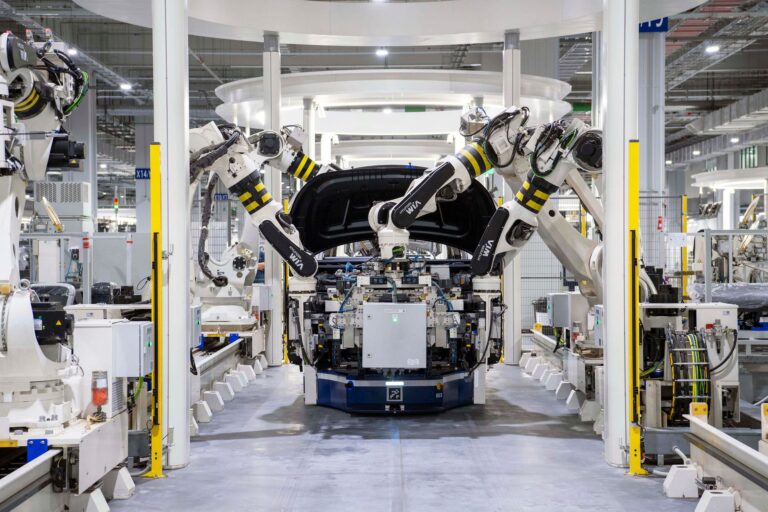
The evidence of Nvidia’s standardization isn’t theoretical. ABB, one of the world’s largest industrial robot manufacturers, has integrated Nvidia Omniverse into its RobotStudio software. This is significant because RobotStudio is where ABB customers program, simulate, and deploy their robots. By embedding Nvidia’s technology here, ABB has effectively made Nvidia’s simulation and optimization tools inseparable from ABB’s core offering. Fanuc and Yaskawa have made similar commitments.
For a customer of any of these three companies, using Nvidia’s tools isn’t an exotic choice; it’s the default path. This integration is expanding beyond the large manufacturers to system integrators and smaller robotics companies. A small team developing a collaborative robot for a specialized manufacturing task can now stand on the shoulders of the ecosystem: download pre-trained vision models, use simulation tools that were battle-tested at ABB, and deploy to Jetson hardware that runs standard software. The barrier to entry drops dramatically. A tradeoff: smaller companies lose some of the flexibility to deeply customize their stack. If you have unusual hardware requirements or want to avoid Nvidia dependencies entirely, the cost of forking from the standard ecosystem is high.
The Risks of a Dominant Standard—What Could Go Wrong
Vendor lock-in is the most obvious risk. Nvidia controls the roadmap for Isaac, Omniverse, and the Jetson platforms. If the company deprioritizes robotics in favor of other markets, or if its hardware strategy diverges from what robotics companies need, the ecosystem has limited recourse. Companies that have built their entire product development process around Nvidia’s tools would face significant rework to transition to alternatives. History offers examples: companies that over-invested in proprietary platforms controlled by single vendors often regretted that decision when the vendor’s priorities shifted. Competition remains a real possibility. Open-source robotics frameworks like ROS (Robot Operating System) provide an alternative foundation, albeit one that requires more assembly and integration work. Cloud providers like AWS and Google are investing in robotics platforms.
Startups could emerge with radically different approaches to robot training and deployment. Nvidia’s dominance isn’t inevitable; it’s contingent on the company continuing to invest in the robotics ecosystem and deliver genuine value. If the company stumbles on innovation, competitors will have room to move in. The broader warning is that standardization around a proprietary platform concentrates power. This can accelerate innovation in the short term—everyone can focus on value-added work rather than infrastructure—but it can also stifle disruption. Any company hoping to challenge Nvidia’s position in robotics starts with a significant disadvantage. They have to be better not just in one dimension, but across multiple dimensions: hardware performance, software quality, simulation accuracy, developer ecosystem, and integration with existing tools. That’s a high bar.
The Physical AI Market Boom
The market fundamentals supporting Nvidia’s position are strong. The projected growth from USD 1.50 billion in 2026 to USD 15.24 billion by 2032 represents a genuine expansion of the robotics market, not a redistribution of existing value. This growth is driven by rising labor costs, advances in AI perception, and the increasing complexity of manufacturing and logistics tasks that robots can handle. Industries from automotive to e-commerce fulfillment to healthcare are investing in robotic automation. That’s demand pulling the entire ecosystem upward.
In this expanding market, Nvidia’s position becomes more entrenched. More robots deployed means more data generated. More data allows for better training of perception and control models. Those models become part of the shared ecosystem, reducing development costs for the next generation of robots. The company with the largest installed base of robots generating data—or with the deepest integration into the tools companies use to manage that data—has an asymmetric advantage. Nvidia has both.
What Industrial Standardization Means for the Future
If Nvidia becomes the industrial standard in robotics, the implications ripple across the industry. For robotics companies, it means competing on application-specific knowledge rather than infrastructure. For customers deploying robots, it means broader compatibility and easier integration across machines from different manufacturers. For the industry overall, it means faster innovation cycles and lower barriers to entry for new applications. Standardization usually accelerates the field.
The longer-term question is whether Nvidia’s position will shift again. In AI, the company’s dominance was challenged by the emergence of custom silicon from cloud providers and potential future disruptions from new architectures. The same dynamic could play out in robotics. But for the next five to ten years, betting against Nvidia as the industrial standard in robotics is betting against momentum, installed base, ecosystem effects, and genuine technical capability. That’s a difficult wager to make.
Conclusion
Yes, Nvidia could be the next industrial standard in robotics. In many ways, it already is becoming one. The company’s position differs from its dominance in AI—it’s more about the platform than the chips alone—but the outcome is similar: a single vendor controlling critical infrastructure that a growing ecosystem depends upon. This standardization has real benefits: faster development cycles, lower costs, broader compatibility. It also has real risks: vendor lock-in, reduced optionality, concentrated power.
For companies in the robotics industry, the question isn’t whether Nvidia will be a dominant player. It’s whether they want to build on top of Nvidia’s platform, build alongside it, or attempt to build a competing ecosystem. Each choice has tradeoffs. For the industry as a whole, the bet is clear: the physical AI market is growing rapidly, and Nvidia has positioned itself at the center of that growth. Unless something fundamental changes—a radical innovation from a competitor, a misstep from Nvidia, or a shift in the competitive landscape—the company’s position as the industrial standard in robotics is likely to strengthen.