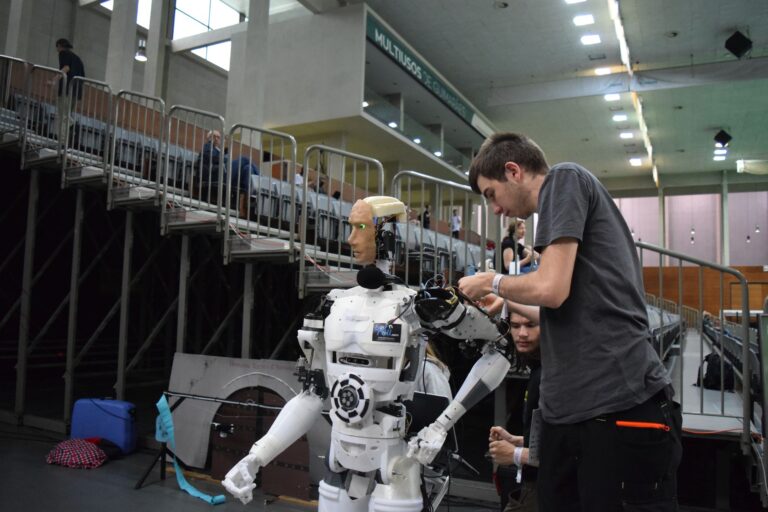

Chinese robotics company UBTECH has unveiled the Walker S2, a humanoid robot designed to keep working by replacing its own depleted battery with a charged one. The dual-battery architecture allows the robot to maintain power during an automated swap, reducing the need to stop a production task for manual charging. In a factory example, a Walker S2 could leave a parts-delivery route, exchange a battery at a dedicated station and then return to moving components between a warehouse and an assembly line. The announcement addresses a persistent weakness in mobile humanoid robots: batteries generally last for only part of a production shift, while recharging can take much longer than swapping a pack.
Automated replacement could support near-continuous operation, but “nonstop” should be understood as an operational target rather than a guarantee. Tool changes, inspections, software faults and mechanical maintenance can still take a robot out of service. UBTECH has positioned the system for industrial work such as material handling, quality inspection and repetitive assembly support. The important development is not simply that the robot carries two batteries, but that it can reportedly identify a low-charge condition, travel to a swapping station and complete the exchange without a worker handling the pack.
Table of Contents
- How Do China’s Dual-Battery Humanoid Robots Support Nonstop Factory Operations?
- Inside the Autonomous Battery-Swapping System
- Where Humanoid Robots Fit on the Factory Floor
- How Factories Should Evaluate Dual-Battery Robot Deployments
- Reliability, Safety and Maintenance Challenges
- Fleet Scheduling and Factory Energy Demand
- Measuring Whether “Nonstop” Operation Is Real
How Do China’s Dual-Battery Humanoid Robots Support Nonstop Factory Operations?
A dual-battery system lets the robot preserve electrical power while one battery is being removed. That distinction matters because a conventional single-pack robot may need to shut down before a battery change, interrupting its software session and requiring a controlled restart. With one pack continuing to power the machine, Walker S2 can retain its operational state while exchanging the other. The approach resembles battery-swapping systems used in some automated mobile robots and electric vehicles, although the Inside the Autonomous Battery-Swapping System
An autonomous swap requires several systems to work together. The robot must monitor the condition of both batteries, decide when an exchange is necessary, navigate to the station and align its body with the mechanical interface. Sensors and control software then need to confirm that the replacement pack is seated, locked and electrically connected before the robot resumes work. The station also becomes part of the factory’s critical infrastructure. It must charge spare batteries, track their temperature and health, and prevent a damaged pack from being returned to service. A poorly maintained connector, obstructed docking area or inaccurate alignment sensor could stop the swap even when the robot itself remains functional. There is also a safety limitation. industrial batteries store substantial energy, and repeated automated handling introduces risks involving damaged cells, loose connections and overheating. Factories cannot treat the swap cabinet as an unattended appliance; it requires inspection, fire-safety planning and isolation procedures comparable to those used for other high-energy industrial equipment. Humanoid robots are intended to operate in spaces and around equipment originally designed for people. Their arms can reach conventional shelves, their hands can interact with familiar tools, and their legs can cross thresholds that may obstruct some wheeled platforms. This makes them candidates for brownfield factories where rebuilding the entire production line would be expensive. A practical example is line-side material handling. A humanoid could collect a tote from a storage rack, carry it to a workstation and place it within an operator’s reach. The task uses human-scale shelves and aisles without requiring a new conveyor, although a wheeled autonomous mobile robot may still move heavier loads more efficiently on a flat floor. Manufacturers are also exploring humanoids for visual inspection and machine tending. A robot could check whether components are present, open a machine door and load a part, but each step requires reliable perception and force control. A successful staged demonstration does not establish that the same system can handle reflective surfaces, misplaced objects or changing light across thousands of production cycles. Factories considering this technology should begin with a narrow, measurable workflow. Suitable pilot tasks have predictable routes, standardized objects and clear recovery procedures. Operators can then track completed cycles, swap failures, human interventions, battery temperatures and unplanned downtime rather than relying on a general claim of continuous operation. The main tradeoff is flexibility versus efficiency. A humanoid may perform several human-oriented tasks with limited changes to the workplace, while a fixed industrial arm will usually be faster and more repeatable at one tightly defined operation. For moving pallets, a forklift or automated guided vehicle may also offer greater payload capacity with less mechanical complexity. Deployment planning should include more than the purchase of robots. A facility may need swapping stations, charging capacity, protected docking zones, wireless coverage, fleet-management software and trained maintenance staff. A dual-battery design can reduce charging interruptions, but it also adds packs, connectors and station mechanisms that must be stocked and serviced. Continuous availability depends on more than battery endurance. Humanoid robots contain numerous actuators, joints, sensors and control computers, and a fault in any of them can interrupt production. Walking machines are particularly sensitive to floor conditions; spilled liquids, loose packaging and uneven transitions can create hazards that a fixed robot never encounters. Battery degradation is another concern. Packs do not age identically, so a fleet manager must track capacity, internal resistance, temperature history and charging cycles for each unit. If an older battery depletes sooner than expected, the robot may make more frequent trips to the swapping station and reduce the productivity gained from automated replacement. Factories should also avoid placing early systems in roles where a sudden stop would trap a person or halt an entire line. Safe separation, speed limits, emergency stops and documented fallback procedures remain necessary. The presence of autonomous battery swapping does not remove the need for risk assessment of the robot’s movements, payloads and interaction with workers. Automated swapping works best when it is managed at fleet level. If several robots request fresh batteries at the same time, a single station can become a queue that shifts downtime rather than eliminating it. Scheduling software can stagger exchanges according to battery condition, task urgency and the availability of charged packs. For example, a factory operating multiple material-delivery robots could direct one machine to swap while others cover active routes. The charging system could also avoid drawing maximum power during a facility’s peak-demand period, provided enough charged batteries remain available for production. A meaningful factory trial should measure total productive time rather than battery-swap success alone. Relevant records include the number of completed tasks, time spent walking without a load, docking attempts, swap duration, operator interventions and maintenance hours. A robot that changes batteries autonomously but frequently needs help grasping parts is not delivering continuous production. Testing should also include imperfect conditions. Engineers can place an object near the docking route, vary the position of a parts bin and run the system through a full shift pattern under supervision. One concrete acceptance criterion is that every failed battery exchange must leave the robot and station in a safe, recoverable state without exposing a live connector or releasing an unsecured pack.Where Humanoid Robots Fit on the Factory Floor
How Factories Should Evaluate Dual-Battery Robot Deployments
Reliability, Safety and Maintenance Challenges
Fleet Scheduling and Factory Energy Demand
Measuring Whether “Nonstop” Operation Is Real
You Might Also Like